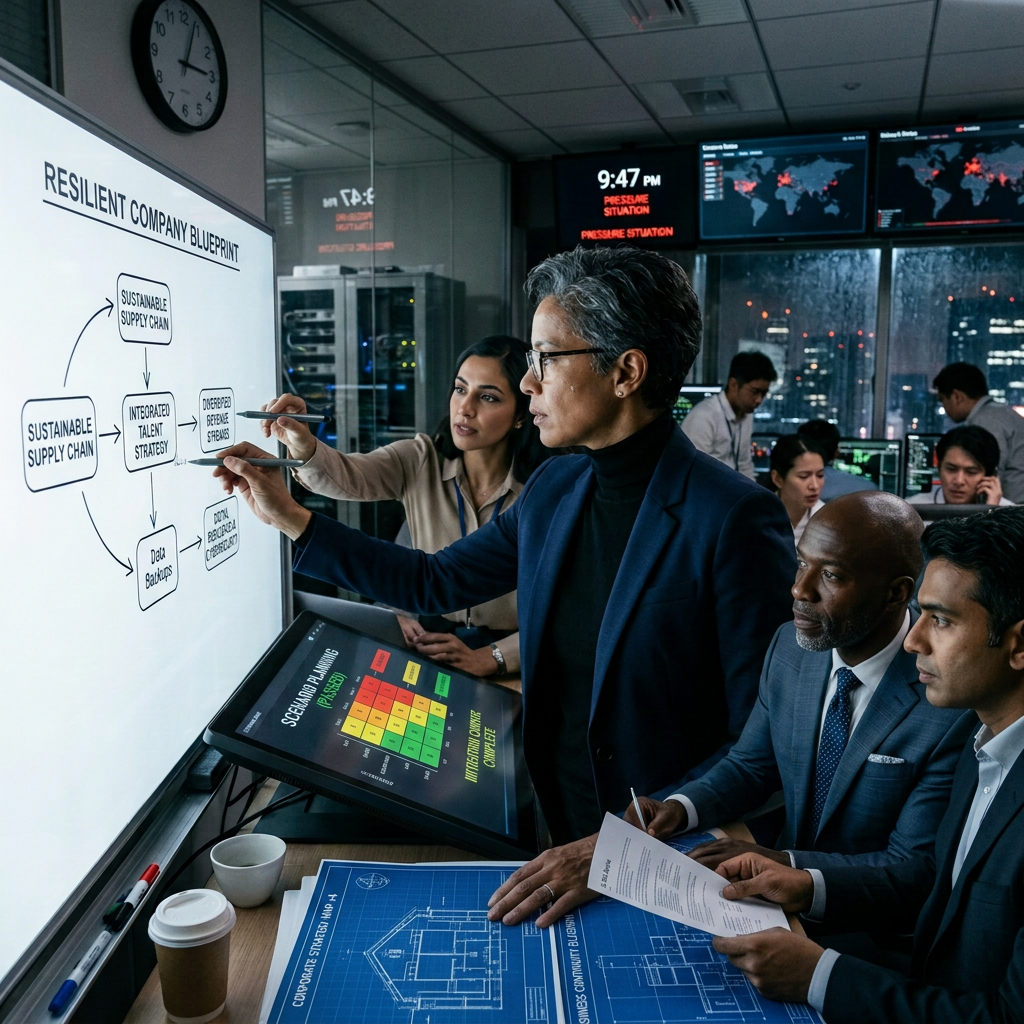
One advantage of entering the CEO role from a deeply technical background is that you never stop seeing systems. That advantage can lead to design strong companies that do not break under pressure.
A technical leader is trained to see dependencies. You see constraints and failure points. You see the gap between what people think the system does and how the system actually behaves, especially under pressure.
For many years, I applied that mindset to technology, security, architecture, and risk. Over time, I realized that same mindset applies just as powerfully to leadership.
Leadership is an architecture problem.
That may sound callous at first. Leadership feels human, emotional, relational, and cultural. It involves empathy, trust, communication, motivation, conflict management, and judgment. But those realities do not make leadership less architectural. They make architecture that much more important.
Every Company Has an Architecture
Organizations, like systems, follow design patterns.
Leaders sometimes design those patterns intentionally. More often, companies inherit them through habit, personality, urgency, legacy decisions, and unspoken assumptions. These things make up an organization’s culture.
Every company has an architecture, whether leaders acknowledge it or not. This is made up of:
- Communication architecture – how information moves, where people distort it, who hears what, and how quickly truth reaches decision-makers.
- Decision architecture – who owns which decisions, what requires escalation, how leaders make tradeoffs, and how the organization avoids paralysis and favors action.
- Accountability architecture – what leaders measure, what they reward, what they tolerate, and what happens when commitments are missed.
- Trust architecture – how teams work together, where friction exists, what people believe leadership truly values, and whether people can raise difficult truths early.
- Resilience architecture – how the organization behaves when revenue pressure rises, customers become unhappy, competitors move, key people leave, or plans fail.
These architectures determine how a company performs.
Pressure Reveals the Design
A weak technical architecture may look fine in a demo and fail in production. I have seen products look great in demo’s and even under controlled conditions. Those same products fail miserably once real load is thrown at them because they were not designed a certain way.
A weak leadership architecture operates in parallel to that. It can look fine in a board update, an all-hands meeting, or a quarterly plan. Then pressure arrives, and the cracks appear.
Decisions slow down. Priorities multiply. Accountability gets blurry. Leaders start doing things to cover up their failures. Teams optimize locally instead of collectively. People sit idle waiting for direction. Teams soften hard truths as those truths move upward.
Leaders often treat those symptoms as people problems first.
In many cases, they are design problems.
One of the most important responsibilities of a CEO is to design the organization so clarity, accountability, and execution can scale. To augment this an organizations needs to know how to fail fast and learn from the failure. Fear of failure cannot be designed into an organization.
The Questions CEOs Should Ask
Some of the key architectural questions a CEO needs to ask about the business are:
- Where do decisions stall?
- Who filters information before it reaches leadership?
- Who are the human single points of failure within this company?
- Where do teams depend on personalities instead of process?
- Where do we reward effort more than outcomes?
- Where have we misaligned incentives?
- Where have we created operational single points of failure?
- Where do we mistake activity for progress?
- Will we survive losing a major lawsuit?
- Where can we make immediate cuts that will have the least impact given a revenue downturn?
Architects ask similar questions about systems. In companies, the components are people, teams, processes, incentives, and operating rhythms.
The CEO does not need to control every component. That would create a grave bottleneck. The CEO needs to make sure the design allows the organization to operate without constant heroic intervention.
Heroics Do Not Scale
Many technical leaders struggle with the transition to lead on a broader scale.
In technical roles, especially earlier in a career, expertise can save the day. You can dive into problems, find flaws, write code, redesign controls, fix architecture deficiencies, or guide the team through solving challenging problems.
But companies cannot scale on heroic intervention.
They scale on transparency, clarity, repeatable mechanisms, qualified leaders, communication that reduces noise instead of creating it, operating cadence, and trust.
Good leadership architecture ultimately makes the right behaviors easier and the wrong behaviors harder.
Weak Architecture Shows Up Everywhere
When priorities remain unclear, the architecture is weak.
If every decision escalates to the CEO, the architecture is weak.
When performance expectations surprise teams, the architecture is weak.
Bad news arriving late exposes a weak architecture.
When people stay busy but outcomes stagnate, the architecture is weak.
Accountability that depends on a personality instead of a structure exposes a weak architecture.
The solution is not more bureaucracy. Bureaucracy often appears when leaders confuse process with architecture. Good architecture does not require more meetings, more approvals, more dashboards, or more reporting layers.
Good architecture creates flow.
It helps information move faster. Ownership becomes clear with goo architecture. It also reduces confusion and exposes risks earlier. Good architecture gives people enough context to make good decisions without waiting for permission or fearing backlash.
Good Leadership Architecture Creates Flow
Flow is important to a company. Anything that disrupts it has a negative impact. In a company, flow is evident in some practical ways:
- Strategy creates flow when everyone knows what matters most.
- Operating rhythm creates flow when teams make decisions at the right cadence.
- Metrics create flow when they reveal reality before problems surprise the business.
- Ownership creates flow when every outcome has a clear, accountable leader.
- Culture creates flow when people can surface hard truths early.
- Communication creates flow when it removes fear, confusion, and speculation.
- Leadership creates flow when direction becomes action, progress, and measurable results.
This is why leaders cannot separate leadership from design.
Culture is not just what leaders say. Culture reflects what the organizational system permits, rewards, ignores, and repeats.
Execution is not just effort. Execution comes from priorities, talent, process, accountability, and timing. Moreover, it is far more about outcomes than effort.
Trust is not just an emotional reaction. Leaders build trust through consistent behavior, transparent decision-making, and the willingness to confront reality no matter how difficult. A great measure of trust is how many of your previous employees would gladly work for you again.
Resilience is not just toughness. Resilience comes from preparation, redundancy, adaptability, and clear authority under pressure. And the only true way to prove resilience is to have successfully survived negative events. Those battle scars say a lot.
The technical world teaches us that systems behave according to design. The business world teaches the same lesson, sometimes more painfully because the stakes are different.
Three Layers Every CEO Must Design
When I think about leadership now, I think about architecture at three levels. Leaders must design the architecture of:
- Clarity – does everyone understand what matters most, why it matters, and how their work connects to the company’s direction?
- Accountability – are commitments explicit, measurable, owned, and reviewed with consistency?
- Trust – can the organization surface truth quickly, challenge assumptions productively, and stay aligned under pressure?
When those three layers are strong, companies move differently. They make faster decisions and recover better from setbacks. Less energy gets wasted on internal turmoil. They also create more space for innovation because people do not constantly need to guess what matters or operate in fear.
The Technical Leader’s Advantage
Technical leaders have a real advantage, if they broaden their lens.
The same systems thinking that helps us understand platforms, networks, applications, and security models can help us understand organizations. The same discipline that helps us design resilient infrastructure can help us design resilient companies.
But technical leaders must recognize one important warning:
People are not servers. Culture is not code. Leadership is not a control plane.
Human systems are more complex because they include emotion, ambition, fear, deceit, trust, pride, fatigue, and belief systems. That does not make architecture irrelevant. It makes it more necessary, albeit more delicate.
The CEO’s Architectural Responsibility
The goal is not to mechanize or roboticize leadership.
The goal is to design an environment where people can do their best work with clarity, ownership, and trust.
That is the CEO’s architectural responsibility.
It’s not to have every answer.
Nor is it to sit at the center of every decision.
Moreover, it is not to personally carry every problem or make every decision.
The CEO aims to design strong companies so they can perform, adapt, and endure. Because in the end, leadership is not just about vision. It is about whether the organization you build can turn that vision into reality under pressure.