Your Biggest Cybersecurity Blind Spot Is How You Make Money

Your Biggest Cybersecurity Blind Spot Is How You Make Money.
Image generated by Jetpack AI, 2026, via WordPress

A huge blind spot may sit inside the decisions that generate your revenue. Growth targets, customer commitments, and operating pressures shape how your people grant access, approve exceptions, and respond to unusual requests. Attackers can exploit those choices. Your biggest cybersecurity blind spot is how you make money.

Look at what your company cannot afford to interrupt, and that is an area where an adversary is likely to apply pressure.

Your revenue engine tells a story. It reveals which customers command exceptions and/or expedient actions, which systems must run as a matter of urgency, and which deadlines override caution. An adversary who understands that story can identify opportunities that a vulnerability scan will never reveal.

Having held engineering, CISO, and CEO roles, I approach this problem from several directions. Growth matters. Customer commitments matter. Cash matters. So does understanding how those priorities influence behavior under pressure.

A security strategy that ignores how the company makes money leaves part of the adversary’s opportunity unexplored.

1. Your Growth Targets Can Reward Dangerous Shortcuts

Growth targets create exposure when employees gain more from completing a transaction than from questioning related risks and/or its legitimacy.

Consider a hypothetical sales team approaching quarter-end. A major prospect requests an urgent integration. The deal requires broad access, while the security review threatens the closing date.

Leadership approves an exception. The integration launches. Everyone celebrates the booking. Meanwhile, nobody owns the related risk, the accountability for security problems, or the deadline for addressing the risk that has been introduced.

That commercial decision has created an opportunity.

An attacker does not need to understand the business opportunity or revenue recognition. They only need to discover that urgency and revenue potential make your organization more accommodating.

Leaders should examine what happens after someone raises a concern. If that person loses recognition while the exception earns praise, the incentive speaks louder than the responsibility to protect the organization.

One interesting question to ask: which business targets and/or processes encourage employees to skip verifications, open up access, or leave exceptions unresolved?

2. Your Largest Customers Can Become Exceptions to Your Rules

Customer concentration creates security pressure when employees fear that enforcing a boundary could damage a critical relationship. And if a business depends heavily on one or a select few customers then this problem grows exponentially. A simple check of Annual Recurring Revenue (ARR) percentages can paint a very clear picture.

A valuable customer, that represents 51% of your ARR, requests a sensitive data export or an unusual support action. The timing coincides closely with a renewal deadline so there is real pressure. Your team recognizes the organization and the timing at hand, they in turn accelerate the fulfillment of the requests.

Familiarity with an account like this does not establish the legitimacy of every request.

An adversary could impersonate a customer contact or compromise that customer contact’s account. Knowledge of the relationship makes the request more convincing. Commercial pressure makes hesitation more expensive.

This is where identity intelligence and business context intersect. Your team needs to understand who requests the action, what authority they hold, and whether the request fits the relationship.

Organizations need to give employees a fast, independent verification route. Make sure executives on both sides support its use when a customer pushes back. After all, this is for the sake of mutual protection and this cannot be ignored considering the level of fraud that exists today.

One interesting question to ask: which customer names cause our people to stop challenging unusual requests?

3. Your Availability Promise Gives Attackers a Pressure Point

A business that depends on continuous service gives adversaries an opportunity to exploit the cost of interruption.

That pressure extends beyond a complete outage. An attacker could target a narrow function that blocks revenue or delivery. Think about something like order releases, customer authentication, production scheduling, or access to operational data.

The technical footprint may feel small. The business consequence may prove enormous.

Consequently, an asset inventory cannot tell the whole story. Security teams need to understand how disruption travels through the business. This is a systemic approach rather than one focused on a specific node.

Focusing on resilience, teams should aim to map the processes that must continue, their dependencies, and the alternatives that can actually keep a business operational. Then, those alternatives need to be pressure tested under realistic constraints. They may be the saving factor in the face of a negatively impacting event.

One interesting question to ask: which single interruption would place leadership under the greatest pressure to make a bad decision?

4. Your Efficiency Strategy Can Concentrate Failure

Efficiency creates concentrated exposure when several business functions depend on the same provider, integration, or privileged identity. This is similar to many disparate software elements all depending on one library.

Consolidation can simplify operations and improve security management. However, it also deserves a clear examination of shared dependencies.

Consider several departments that rely on one platform. Each department documents its own business continuity plan. Yet every plan assumes the same platform will remain available.

The organization has several plans and one single point of failure.

Shared service accounts and administrative integrations can create a similar problem. A compromise in one location may give an adversary influence across multiple workflows.

Teams need to evaluate the scope of access, the ability to isolate affected functions, and the practical cost of operating without some dependency. Treat those findings as inputs to future efficiency decisions.

One interesting question to ask: where have we reduced operating costs by concentrating authority or eliminating a workable alternative?

5. Your Customer Experience Can Weaken Identity Checks

Customer experience goals create exposure when teams remove verification steps without preserving reliable ways to establish identity and authority.

Account recovery makes this tension obvious. A legitimate customer wants immediate access (quite often with a loud voice). A support employee wants to resolve the problem quickly. An adversary wants the same outcome as the customer: control of the account.

If your workflow rewards speed above all else, the attacker can vibe hack (use frustration, create a sense of urgency, utilize personal details, etc) their way to pushing the interaction forward.

Accurate information about someone does not prove that the requester is that person. Likewise, successful authentication does not justify every subsequent action.

These days teams should aim to design additional verification around consequential actions, including recovery, privilege changes, and sensitive exports. Leadership needs to give support teams a clear escalation path that preserves service quality.

One interesting question to ask: can someone use our commitment to customer excellence to obtain access they could not otherwise gain?

6. Your Automation Can Simply Execute the Wrong Business Decision Faster

Automation amplifies exposure when systems act on manipulated inputs with more authority than the task requires.

Imagine a workflow that accepts a supplier change, updates a record, and initiates downstream actions. An attacker who influences the input may redirect the process without exploiting a software vulnerability.

An AI agent with delegated access adds another decision point. Leaders must understand what evidence the agent trusts and which actions it can initiate.

The business objective may sound harmless: resolve requests faster. The implementation may grant authority to change records, release information, or commit resources.

There needs to be a separation of low-impact assistance from consequential execution. Aim to limit authority, verify sensitive changes through independent channels, and preserve a practical way to stop the workflow.

One interesting question to ask: what could an adversary accomplish if our automation accepted a convincing but malicious request?

7. Your Culture Can Hide the Warnings Leadership Needs

A culture that penalizes delay or unwelcome news makes it harder for leadership to recognize exploitable conditions.

Employees learn which concerns leaders welcome. They also learn which concerns threaten a launch, embarrass an executive, or complicate a forecast. Moreover, they learn which actions threaten their livelihood.

Over time, people may soften their language, defer escalation, or handle exceptions quietly. Leadership then makes decisions with an incomplete picture.

An adversary benefits from that gap.

CEOs should examine how their own behavior shapes escalation. When someone challenges a commercially attractive decision, do you investigate the concern? Or do you demand a workaround before understanding the exposure?

Make someone accountable for each exception, including its scope, expiration, and corrective action. Reward employees who surface a problem early enough to address it. Also, reward employees who scrutinize situations to ensure nothing fraudulent is at hand.

One interesting question to ask: what do our people already know that our leadership team makes difficult to say?

Put the Business Model Inside Your Threat Model

Leaders can start addressing some of these risks by testing how an adversary could exploit the company’s most important commercial workflows.

Start with one process that generates revenue or delivers a critical service. Bring its business owner together with security and engineering.

Trace:

  • Who requests an action?
  • Who authorizes said action?
  • What evidence does the authorizer trust?
  • Which systems execute the action?

Based on those answers, identify where urgency changes the rules. Then test a plausible abuse scenario. Consider these questions:

  • Could a convincing customer request trigger an unauthorized data export or action?
  • Could a supplier impersonator redirect a workflow?
  • Could one compromised identity interrupt multiple services?

Use the findings to change processes accordingly. The “if it ain’t broke don’t fix it” approach is not applicable here. Assign an owner to be held accountable for scrutinization and adjustments, set a deadline, and test whether the change blocks the abuse. The “test” part is very relevant here as this should be done by a competent entity and with the same rules of engagement that nefarious actors follow … none.

This is how the adversarial mindset becomes a business discipline. It forces leadership to examine how someone could turn the organization’s priorities against it.

This does require that a CISO understand the revenue engine at hand. A CEO needs to understand the exposure that engine creates. Both need the authority to act on what they discover. The CEO usually has this but the CISO may not.

Your business model explains how you intend to win. Study it closely enough to understand how an adversary could use it against you because your biggest cybersecurity blind spot is how you make money.


Why AI Governance Is Now a Critical Leadership Responsibility

Why AI Governance Is Now a Critical Leadership Responsibility.
Image generated by Jetpack AI, 2026, via WordPress

Unfortunately, many organizations are on the path to repeat one of the most consequential mistakes that we have made in this industry. AI Governance is now a critical leadership responsibility.

For years, executive leaders treated cybersecurity as a technical issue. It was convenient to tuck it away under Information Technology (IT) and it became someone else’s problem. They delegated it to specialists, discussed it only when budgets or incidents demanded attention, and assumed that technical teams could contain the risk.

Then the breaches became business disruptions. Regulatory consequences reached the CFO as well as the boardroom. Trust degraded, especially from customers. Operations stopped. Executives discovered that although they could delegate security work, they could not delegate accountability for the outcome. Tucking it conveniently inside of IT was no longer an option.

Artificial Intelligence (AI) is now following an eerily similar path, only much faster.

Many organizations still treat AI governance as a collection of technical controls, acceptable-use policies, legal reviews, and model assessments. They assign it to IT, data science, security, privacy, or compliance and assume those functions can govern the technology on behalf of the enterprise.

Simply put, they cannot.

Those teams can implement controls, evaluate models, monitor systems, and advise the business. They cannot independently decide which risks the organization should accept, which decisions should be influenced by AI or automation, where humans must retain authority, or who remains accountable when an AI-enabled processes have a negative impact.

Those are leadership decisions.

AI governance is not a technical specialization that executives can delegate. It is a leadership capability that executives must develop.

Leadership Cannot Outsource Accountability

I have spent much of my career moving between deeply technical responsibilities and executive leadership. I have worked in federal law enforcement technology, application architecture, offensive security, cybersecurity, the CISO function, the CTO function, and the CEO role.

Those experiences repeatedly reinforced the same lesson: technology may create the mechanism, but leadership creates the consequence.

For me, it took a while but that had to sink in as I lived my professional journey.

An algorithm does not determine whether an organization should use AI to evaluate employees, prioritize customers, detect fraud, approve transactions, recommend medical actions, or automate security responses. Leaders make those decisions.

The system may generate a recommendation, classification, or action. It does not absorb responsibility for the result. It simply generates an output.

A model cannot accept enterprise risk.

A chatbot is likely to not be able to explain a decision to an auditor.

An autonomous agent cannot appear before the board and defend the authority it was granted.

The human signature may become less visible as the footprints of AI and automation increase, but it does not disappear. It moves upward through the organization until it reaches the leaders who authorized these systems, established their boundaries (hopefully), funded their deployments, and accepted the risks at hand (again, hopefully).

AI Means More Than Generative AI

One reason organizations misunderstand AI governance is that most current conversations concentrate so heavily on Generative AI (GenAI). And the notion of “AI” in those conversations is incorrectly used to mean “GenAI”.

Large Language Models (LLMs), copilots, image generators, and conversational interfaces have made a subset of AI (GenAI) visible to almost everyone. They have also narrowed the discussion.

AI as a field extends far beyond generated text and images. Some organizations already use AI to:

  • Detect financial fraud and account takeover.
  • Score credit and insurance risk.
  • Identify cyber threats and automate containment.
  • Rank candidates and evaluate employee performance.
  • Recognize faces, objects, behaviors, and anomalies.
  • Predict equipment failures and optimize industrial processes.
  • Recommend products, services, prices, and content.
  • Route vehicles, shipments, and supply-chain resources.
  • Support medical diagnosis and clinical decisions.
  • Operate robots, sensors, and autonomous systems.

These systems may never generate a paragraph, but they can still shape someone’s employment, financial access, safety, privacy, or treatment.

Leaders who define AI governance as a policy for using ChatGPT will govern only the most visible layer of a much larger technology landscape.

Every system that predicts, accepts, rejects, classifies, recommends, prioritizes, optimizes, or acts should fall within the governance conversation. Yet, the limited understanding of where AI actually exists within organizations does not make that proper conversation possible.

AI Governance Begins With Ownership

Every material AI system needs an accountable owner. It doesn’t need a committee or some vague reference to “the business.”

A named leader must own the business purpose, risk, performance, and consequences of the system.

Technical ownership also matters, but it is not the same as business accountability. A data science team may build a model. A cloud team may host it. Security may monitor it. Legal may review it. None of those activities answers this central question:

Who has the authority to decide that this system should operate?

Ownership must extend across the AI lifecycle:

  • Who approved the use case?
  • Who authorized the data?
  • Who selected or developed the model?
  • Who defined acceptable performance?
  • Who approved production deployment?
  • Who monitors changes in behavior?
  • Who can suspend the system?
  • Who is accountable for the outcome?

When organizations cannot answer those questions, they do not have governance. They have the illusion of governance via distributed activity and no focused accountability.

Leaders Must Establish AI Risk Appetite

Many organizations speak about AI principles. Fewer define their AI risk appetite.

Principles describe what an organization values. Risk appetite determines what it will permit.

Effective leadership demands decisions around where AI may operate autonomously, where it may only recommend, and where it should not participate at all.

That requires decisions about:

  • Which data AI systems may access.
  • Which decisions may be automated.
  • Which decisions require human approval.
  • How much uncertainty the organization will tolerate.
  • What level of explainability a use case requires.
  • How much authority and/or autonomy an AI agent may receive.
  • Which failures require immediate shutdown.
  • When efficiency cannot outweigh safety, fairness, privacy, or trust.

For example, a fraud-detection model and an autonomous industrial controller should not operate under identical tolerance levels. Neither should a marketing assistant and a system that affects employment or access to employee resources.

Optimally, governance reflects potential consequence.

That judgment cannot come exclusively from a technical scoring system. It requires leaders who understand the organization’s culture, strategy, customers, obligations, operations, and values.

Human Oversight Must Be Real

“Human in the loop” has become a very overused phrase in AI governance.

Organizations often point to human review as evidence that a system remains under control. But placing a person near an automated decision does not guarantee meaningful oversight. Nor does it even reflect reality in some cases. The sheer volume of what AI powered systems can generate make human intervention questionable.

The human may lack sufficient time and/or information to challenge the system. The interface may encourage automatic approval. Time pressure may make careful review impossible. Employees may assume that the model is more accurate than they are. Responsibility may become so distributed that nobody feels empowered to intervene.

Realistically, human oversight requires more than a final approval button.

The reviewer must have:

  • Enough context to understand the decision.
  • Enough authority to reject or override it.
  • Enough time to exercise independent judgment.
  • Enough technical literacy to recognize uncertainty.
  • Enough organizational protection to challenge the system.

Effectively, leaders must also consider automation bias. This is the natural tendency for people to trust the output of a system that appears objective, complex, or authoritative.

Ultimately, the human factor does not disappear when AI enters a workflow. It becomes more complicated.

Identity and Authority Form the AI Control Plane

Oddly, many AI governance discussions often focus on models and data while overlooking identity.

That is a serious mistake.

People build AI systems. Service accounts train them. Pipelines deploy them. Applications invoke them. Administrators change them. Agents increasingly act through them.

Every step involves an identity exercising authority.

An organization must know:

  • Who or what is acting.
  • Which identity the actor represents.
  • What authority that identity possesses.
  • What constraints exist on that authority.
  • Who granted that authority.
  • Whether the authority remains appropriate.
  • Whether the identity remains trustworthy.

This becomes especially important with autonomous agents. An agent may retrieve information, call APIs, create accounts, modify configurations, communicate with customers, or initiate actions.

An agent should not receive unrestricted access simply because an authenticated employee launched it.

It needs its own identity, constrained privileges, defined purpose, limited duration, attributable owner, and immediate revocation path.

The organization should preserve the full chain of authority:

  1. Human initiator
  2. Agent identity
  3. Delegated permission
  4. Tool invocation
  5. Impacted resource

Without that chain, the organization cannot distinguish legitimate automation from compromised autonomy.

The Adversary Gets a Vote

AI governance cannot operate only under the assumption that people and systems will behave as intended.

Adversaries couldn’t care less about the rules. They will manipulate models, compromise identities, poison data, steal credentials, exploit integrations, and misuse legitimate functionality.

They will search for the gap between what leaders think the system does and how it actually behaves under pressure.

This is where an adversarial mindset becomes essential.

Leaders should not ask only, “Does the system work?” In a headspace where there are no limits, they should also ask:

  • How could someone intentionally misuse it?
  • What happens if its data becomes untrustworthy?
  • Could a compromised identity change its behavior?
  • Can an attacker manipulate the human reviewer?
  • What authority could the system silently accumulate over time?
  • How would we detect subtle rather than catastrophic failure?
  • Can we stop it before we fully understand the incident?

Governance that assumes normal behavior is policy. And look at how effective policies are at stopping nefarious actors.

Governance that anticipates manipulation is a healthy step towards resilience.

AI Governance Must Become an Operating Rhythm

Organizations will not govern AI effectively through a policy, its annual review, or a one-time model assessment.

AI systems change. Their data changes. As do their users. Their integrations expand while authority grows. Their behavior may also shift as the environment around them changes. All of this is also happening at a rate of speed many organizations are not prepared for.

Governance must therefore become part of the organization’s operating rhythm.

Executive teams should receive recurring visibility into:

  • The inventory of blindly discovered (approved and unapproved) AI systems.
  • High-consequence use cases.
  • Detected changes in model behavior or authority.
  • Exceptions to established guardrails.
  • Third-party and supply-chain dependencies.
  • Identity exposure affecting AI environments.
  • Evidence that human oversight remains effective.

The objective is not to force leaders to review algorithms. One is to ensure that leadership understands where the organization has transferred decision-making power to machines and what could happen if that transfer fails. Another is to build a cadence of readiness preparation so that negative surprises are minimized.

Five Questions Executive Leaders Should Ask Now

Every executive team should be able to answer five questions:

  1. Where is AI already influencing decisions or actions across the organization?
  2. Who owns each material AI system and remains accountable for its outcomes?
  3. Which decisions may AI make autonomously, recommend to a human, or never influence?
  4. Can we trace every important AI action to a human or non-human identity and its delegated authority?
  5. Can we suspend the system quickly when its behavior, data, identity, or operating environment becomes untrustworthy?

If leadership cannot answer those questions, the organization is not ready to deploy and/or scale AI responsibly.

Leadership Is the Ultimate AI Control

Technical teams will remain essential to AI governance. Organizations need skilled architects, data scientists, security professionals, privacy experts, engineers, and legal counsel.

But expertise does not replace executive accountability.

AI will compress the distance between a leadership decision and its technological consequences. A policy choice can become an automated workflow. A risk tolerance can become a model threshold. A poorly governed identity can become an autonomous actor.

The organizations that succeed will not necessarily be those that adopt AI fastest.

They will be the organizations whose leaders understand where AI should have authority, establish clear boundaries around that authority, demand attributable ownership, anticipate adversarial behavior, and retain the ability to intervene.

We eventually learned that cybersecurity was not merely a technology problem.

We should not need another decade of incidents to learn the same lesson about AI.

AI Governance is now a critical leadership responsibility, it is also a leadership test.

The outcomes will reveal who studied and prepared for that test.

Technical CEOs Design Strong Companies That Do Not Break Under Pressure

How Technical CEOs Design Strong Companies That Do Not Break Under Pressure.
Image generated by Jetpack AI, 2026, via WordPress

One advantage of entering the CEO role from a deeply technical background is that you never stop seeing systems. That advantage can lead to design strong companies that do not break under pressure.

A technical leader is trained to see dependencies. You see constraints and failure points. You see the gap between what people think the system does and how the system actually behaves, especially under pressure.

For many years, I applied that mindset to technology, security, architecture, and risk. Over time, I realized that same mindset applies just as powerfully to leadership.

Leadership is an architecture problem.

That may sound callous at first. Leadership feels human, emotional, relational, and cultural. It involves empathy, trust, communication, motivation, conflict management, and judgment. But those realities do not make leadership less architectural. They make architecture that much more important.

Every Company Has an Architecture

Organizations, like systems, follow design patterns.

Leaders sometimes design those patterns intentionally. More often, companies inherit them through habit, personality, urgency, legacy decisions, and unspoken assumptions. These things make up an organization’s culture.

Every company has an architecture, whether leaders acknowledge it or not. This is made up of:

  • Communication architecture – how information moves, where people distort it, who hears what, and how quickly truth reaches decision-makers.
  • Decision architecture – who owns which decisions, what requires escalation, how leaders make tradeoffs, and how the organization avoids paralysis and favors action.
  • Accountability architecture – what leaders measure, what they reward, what they tolerate, and what happens when commitments are missed.
  • Trust architecture – how teams work together, where friction exists, what people believe leadership truly values, and whether people can raise difficult truths early.
  • Resilience architecture – how the organization behaves when revenue pressure rises, customers become unhappy, competitors move, key people leave, or plans fail.

These architectures determine how a company performs.

Pressure Reveals the Design

A weak technical architecture may look fine in a demo and fail in production. I have seen products look great in demo’s and even under controlled conditions. Those same products fail miserably once real load is thrown at them because they were not designed a certain way.

A weak leadership architecture operates in parallel to that. It can look fine in a board update, an all-hands meeting, or a quarterly plan. Then pressure arrives, and the cracks appear.

Decisions slow down. Priorities multiply. Accountability gets blurry. Leaders start doing things to cover up their failures. Teams optimize locally instead of collectively. People sit idle waiting for direction. Teams soften hard truths as those truths move upward.

Leaders often treat those symptoms as people problems first.

In many cases, they are design problems.

One of the most important responsibilities of a CEO is to design the organization so clarity, accountability, and execution can scale. To augment this an organizations needs to know how to fail fast and learn from the failure. Fear of failure cannot be designed into an organization.

The Questions CEOs Should Ask

Some of the key architectural questions a CEO needs to ask about the business are:

  • Where do decisions stall?
  • Who filters information before it reaches leadership?
  • Who are the human single points of failure within this company?
  • Where do teams depend on personalities instead of process?
  • Where do we reward effort more than outcomes?
  • Where have we misaligned incentives?
  • Where have we created operational single points of failure?
  • Where do we mistake activity for progress?
  • Will we survive losing a major lawsuit?
  • Where can we make immediate cuts that will have the least impact given a revenue downturn?

Architects ask similar questions about systems. In companies, the components are people, teams, processes, incentives, and operating rhythms.

The CEO does not need to control every component. That would create a grave bottleneck. The CEO needs to make sure the design allows the organization to operate without constant heroic intervention.

Heroics Do Not Scale

Many technical leaders struggle with the transition to lead on a broader scale.

In technical roles, especially earlier in a career, expertise can save the day. You can dive into problems, find flaws, write code, redesign controls, fix architecture deficiencies, or guide the team through solving challenging problems.

But companies cannot scale on heroic intervention.

They scale on transparency, clarity, repeatable mechanisms, qualified leaders, communication that reduces noise instead of creating it, operating cadence, and trust.

Good leadership architecture ultimately makes the right behaviors easier and the wrong behaviors harder.

Weak Architecture Shows Up Everywhere

When priorities remain unclear, the architecture is weak.

If every decision escalates to the CEO, the architecture is weak.

When performance expectations surprise teams, the architecture is weak.

Bad news arriving late exposes a weak architecture.

When people stay busy but outcomes stagnate, the architecture is weak.

Accountability that depends on a personality instead of a structure exposes a weak architecture.

The solution is not more bureaucracy. Bureaucracy often appears when leaders confuse process with architecture. Good architecture does not require more meetings, more approvals, more dashboards, or more reporting layers.

Good architecture creates flow.

It helps information move faster. Ownership becomes clear with goo architecture. It also reduces confusion and exposes risks earlier. Good architecture gives people enough context to make good decisions without waiting for permission or fearing backlash.

Good Leadership Architecture Creates Flow

Flow is important to a company. Anything that disrupts it has a negative impact. In a company, flow is evident in some practical ways:

  • Strategy creates flow when everyone knows what matters most.
  • Operating rhythm creates flow when teams make decisions at the right cadence.
  • Metrics create flow when they reveal reality before problems surprise the business.
  • Ownership creates flow when every outcome has a clear, accountable leader.
  • Culture creates flow when people can surface hard truths early.
  • Communication creates flow when it removes fear, confusion, and speculation.
  • Leadership creates flow when direction becomes action, progress, and measurable results.

This is why leaders cannot separate leadership from design.

Culture is not just what leaders say. Culture reflects what the organizational system permits, rewards, ignores, and repeats.

Execution is not just effort. Execution comes from priorities, talent, process, accountability, and timing. Moreover, it is far more about outcomes than effort.

Trust is not just an emotional reaction. Leaders build trust through consistent behavior, transparent decision-making, and the willingness to confront reality no matter how difficult. A great measure of trust is how many of your previous employees would gladly work for you again.

Resilience is not just toughness. Resilience comes from preparation, redundancy, adaptability, and clear authority under pressure. And the only true way to prove resilience is to have successfully survived negative events. Those battle scars say a lot.

The technical world teaches us that systems behave according to design. The business world teaches the same lesson, sometimes more painfully because the stakes are different.

Three Layers Every CEO Must Design

When I think about leadership now, I think about architecture at three levels. Leaders must design the architecture of:

  • Clarity – does everyone understand what matters most, why it matters, and how their work connects to the company’s direction?
  • Accountability – are commitments explicit, measurable, owned, and reviewed with consistency?
  • Trust – can the organization surface truth quickly, challenge assumptions productively, and stay aligned under pressure?

When those three layers are strong, companies move differently. They make faster decisions and recover better from setbacks. Less energy gets wasted on internal turmoil. They also create more space for innovation because people do not constantly need to guess what matters or operate in fear.

The Technical Leader’s Advantage

Technical leaders have a real advantage, if they broaden their lens.

The same systems thinking that helps us understand platforms, networks, applications, and security models can help us understand organizations. The same discipline that helps us design resilient infrastructure can help us design resilient companies.

But technical leaders must recognize one important warning:

People are not servers. Culture is not code. Leadership is not a control plane.

Human systems are more complex because they include emotion, ambition, fear, deceit, trust, pride, fatigue, and belief systems. That does not make architecture irrelevant. It makes it more necessary, albeit more delicate.

The CEO’s Architectural Responsibility

The goal is not to mechanize or roboticize leadership.

The goal is to design an environment where people can do their best work with clarity, ownership, and trust.

That is the CEO’s architectural responsibility.

It’s not to have every answer.

Nor is it to sit at the center of every decision.

Moreover, it is not to personally carry every problem or make every decision.

The CEO aims to design strong companies so they can perform, adapt, and endure. Because in the end, leadership is not just about vision. It is about whether the organization you build can turn that vision into reality under pressure.

How to Lead With Confidence When Certainty Disappears

How to Lead With Confidence When Certainty Disappears
Image generated by Jetpack AI, 2026, via WordPress

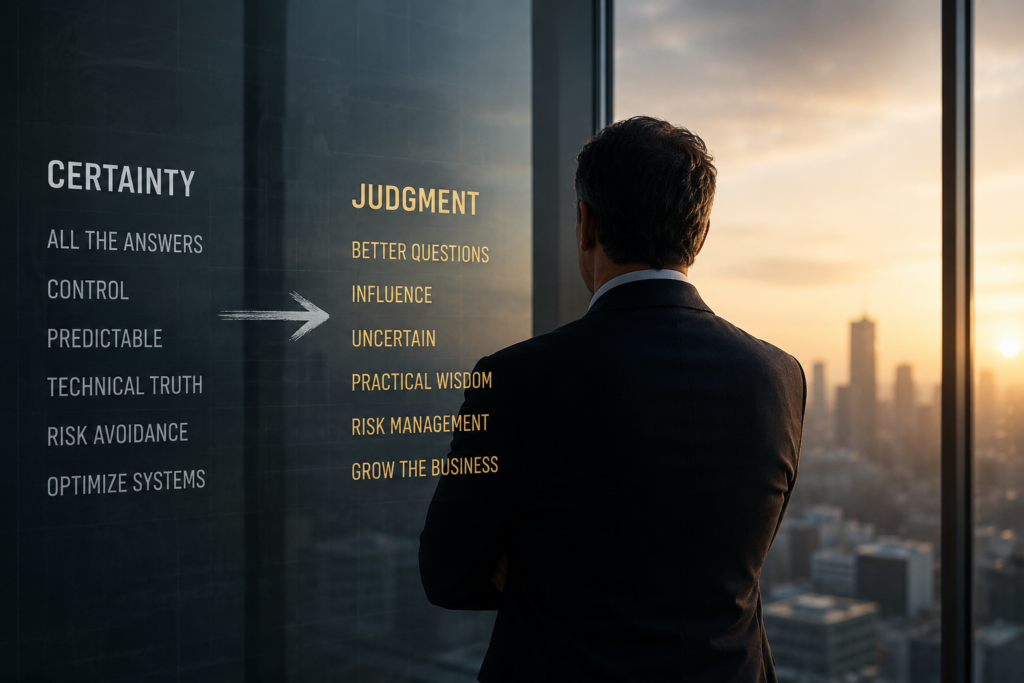
For much of my career, I lived in worlds where precision mattered. The hardest shift from a technology or security leader to CEO is trading certainty for judgment. In this executive leadership world a key ability is being able to lead with confidence when certainty disappears.

From Precision to Ambiguity

As a technologist, architect, CTO, and CISO, I was trained to look for edge cases, root causes, system behavior, technical truths, and to have defensible answers. When something failed, the goal was to understand why as soon as the disaster was dealt with. When risk surfaced, the goal was to measure it, contain it, and communicate it. When a system needed to scale, the goal was to design something resilient enough to survive negative impact.

That background is incredibly valuable as it sharpens how you think. It also teaches you to respect complexity while separating signal from noise. That operating system also gives you a deep appreciation for how fragile things can become when assumptions go untested.

The Real Shift: Certainty to Judgment

Becoming a CEO requires a different operating system.

The hardest shift is not going from technology to business. It is going from certainty to judgment.

In technical leadership, you often have the luxury of eventually getting to a correct answer. The system works or it does not. There is a reality to a functional state. A control is effective or it isn’t. An architecture scales or it breaks. Vulnerabilities are exploitable or they aren’t. Even when there is debate, there is usually a path toward some solution.

As CEO, the path is rarely that clean.

Leading When the Answer Is Not Obvious

Unfortunately, CEOs have to make decisions with incomplete information. That is simply part of the job’s reality. You balance financial realities, customer needs, market timing, employee morale, board expectations, competitive pressure, and operational constraints. There is a mental state where you are constantly choosing between options that all carry risk. Sometimes the decision is not between right and wrong. It is between imperfect and necessary.

That is a very different kind of pressure.

Risk Is Only One Part of the Equation

A CISO is often rewarded for identifying what could go wrong. A CEO is responsible for deciding what must go forward irrespective of risk.

That does not mean ignoring risk. It means understanding that risk is only one part of the enterprise equation. Growth has risk. Inaction has risk. Delay has risk. Over-analysis has risk. Moving too slowly can be just as damaging as moving too fast.

This was one of the most important mindset changes for me.

As a security leader, I spent years helping organizations avoid bad outcomes. I analyzed as many angles as I could and prepared in the most realistic way possible. As a CEO, I still care deeply about avoiding bad outcomes, but I also have to create the conditions for positive outcomes. After all, I have a company to run and grow. That means building momentum, making tradeoffs, allocating capital, setting priorities, developing leaders, and helping the company move with conviction even when the data is not perfect. Sometimes it means deciding between a gamble that could improve ARR or mitigating risk.

Technical Depth Can Become a Constraint

As expected, technical leaders often bring a powerful bias toward depth. We want to understand details and inspect machinery. Often, knowing why something is happening is essential before action takes place.

That instinct is useful. But it can also become a constraint.

As an example, imagine a scenario where sales leadership does not know intimate details about a potential customer. You ask questions such as who the economic buyer really is, what the internal deadlines are, or what their budget is. These are details that dictate how real a deal is and whether you put that data in front of the board. But realistically, those details are likely not made known to a sales person by the potential customer. My bias for depth just became both a constraint and source of frustration.

The CEO’s Job Is to Build Decision Capacity

Realistically, a CEO cannot personally inspect every system, approve every decision, or resolve every ambiguity. The job is not to become the ultimate escalation point for every hard problem. Staying focused, as a CEO you want to build an organization that can make better decisions without waiting for you.

That requires trust.

Trust in people, in operating rhythms, in the quality of the strategy, in the mechanisms that surface truth early. It also requires a leadership tier that understands the business, mission, constraints, and relevant standards.

As a CEO you must accept that no amount of technical brilliance eliminates uncertainty.

Judgment Is the CEO’s Most Important Tool

Given the reality of uncertainty, judgment becomes the CEO’s most important tool.

Judgment is not instinct alone. Nor is it guessing. Judgment is the ability to combine facts, experience, pattern recognition, timing, and foreseen consequences into a decision that moves the organization forward.

Good judgment asks:

  • What do we know?
  • What do we not know?
  • What assumptions are we making?
  • What happens if we are wrong?
  • What must be true for this decision to work?
  • What is the cost of a given decision?
  • What is the cost of not deciding now and waiting?
  • Who needs clarity now?

A Practical Framework for Leading When Certainty Disappears

Confidence under uncertainty does not come from pretending to have all the answers. It comes from using a disciplined process to turn incomplete information into responsible action. When the path forward is unclear, I use the following eight steps:

Accept That Certainty May Not Arrive

Recognize that consequential leadership decisions often must be made before every fact becomes available. Waiting for complete certainty can become its own decision, carrying costs and risks that may exceed those of taking action.

Separate What You Know From What You Do Not Know

Identify the reliable facts, the missing information, and the areas where uncertainty remains. This type of compartmentalization prevents assumptions, opinions, and incomplete signals from being treated as established truth.

Expose Your Assumptions

Make the assumptions behind the decision explicit and determine which ones carry the greatest risk. An assumption left unspoken can quietly become a serious risk and even a single point of failure.

Evaluate the Consequences

Consider what happens if the decision is wrong and how the effects could spread across the organization. Look beyond the immediate outcome to the potential larger impact on customers, employees, cash, execution, and credibility.

Compare Action With Inaction

Assess the cost of acting, the cost of waiting, and the risks created by delay or excessive analysis. Inaction can be very expensive. Leaders often examine the downside of moving forward without giving equal attention to the downside of standing still.

Define what must be

Determine the conditions required for the decision to succeed. Then assess whether those conditions already exist, can be created, or depend on factors outside the organization’s control.

Make and communicate the decision

Establish a clear direction, explain what matters most, and give the people who must act the clarity they need. Communicate what you know, what you believe, what you have decided, and what the organization must do next.

Adapt as reality provides new information

Lead as transparently as possible, with honest conviction rather than false certainty. Monitor the results, test the assumptions behind the decision, and adjust the course as new facts emerge.

This process does not eliminate uncertainty. It creates the decision capacity required to move through it responsibly. The objective is not to predict every outcome. It is to make the strongest available decision, communicate it clearly, and remain ready to adapt.

The Company Is Now the System

Some of those questions are familiar to technical leaders. They sound a lot like risk analysis, incident response, architecture review, and threat modeling. The difference is that, as CEO, they now apply to areas (e.g., Sales, Marketing, HR) technical leaders seldom manage. In fact, they now apply to the whole company.

Strategy becomes an architecture problem. Culture becomes a scaling problem. Communication becomes a signal integrity problem. Talent becomes a resilience problem. Cash becomes an operating constraint. Execution becomes the ultimate proof point.

The CEO role forces you to widen the aperture.

You can no longer look only at whether something is functional or technically sound. You have to ask whether it is commercially viable, operationally executable, strategically aligned, and fiscally responsible. You have to think about how decisions cascade across customers, employees, investors, partners, and the broader market.

Credibility Changes at the CEO Level

That broader blast radius for each decision made is where the CEO transition can feel uncomfortable for deeply technical leaders.

We are used to being credible because of what we know. As CEO, credibility increasingly comes from how we decide, how we communicate, and how we create clarity for others, even when conditions are hazy.

The organization does not need the CEO to have every answer.

It needs the CEO to establish clear direction.

It needs the CEO to make the hard calls.

It needs the CEO to define what matters most.

It needs the CEO to be calm when the data is incomplete and when the pressure is on.

It needs the CEO to turn ambiguity into action.

Conviction Without False Certainty

To be clear, none of this means pretending to be certain. In fact, false certainty is dangerous. People can feel when a leader is manufacturing confidence. The better posture is honest conviction: here is what we know, here is what we believe, here is what we are going to do, and here is how we will adapt as reality teaches us more.

That is a different kind of leadership maturity.

The transition from CISO or CTO to CEO is not a rejection of technical depth. It is an expansion of it. The same disciplines still matter: systems thinking, adversarial understanding, resilience, risk management, architecture, and operational rigor.

The difference is that they must be applied at a broader level.

The company is now the system.

The market is now the threat model.

The competition is now an adversary.

The strategy is now the architecture.

The people are now the execution layer.

And the CEO is responsible for whether all of it works together under pressure.

Your Expertise Got You Here. Judgment Determines What Happens Next.

For technical leaders aspiring to broader executive roles, this is the real lesson: your expertise got you to the table, but judgment determines your impact once you are there.

Depth still matters. Precision still matters. Technical fluency still matters.

But the role changes.

You are no longer only protecting the business.

You are leading it.

You are growing it.

And leadership, at the CEO level, is the discipline of making consequential decisions before certainty arrives.