
Fuzed Identities and the Collapse of the Corporate-Personal Security Boundary

Fuzed Identities and the Collapse of the Corporate-Personal Security Boundary

The collapse of the corporate-personal security boundary is upon us. Cybersecurity has spent decades protecting accounts while adversaries have concentrated on compromising people.

That distinction is becoming increasingly consequential.

Enterprise identity systems divide a person into manageable objects: an employee record, directory account, email address, mobile number, device registration, cloud identity, privileged account, and application entitlement. Each object is assigned to a platform, protected by controls, and evaluated within a defined organizational boundary.

The individual behind those objects does not live within that boundary.

The same person maintains multiple personal email accounts, mobile devices, usernames, social profiles, messaging accounts, browser sessions, payment identifiers, cloud applications, and years of accumulated digital exposure. Those identities intersect with the enterprise whenever the person opens a work document on a personal device, reuses a password, accesses work from a personal device, stores a business session in a browser, uses a personal telephone number for recovery, or becomes the target of an infostealer.

For the adversary, there is no meaningful distinction between an employee’s corporate identity and personal identities. There is simply a collection of possible routes to the same human target.

This reality requires a new security construct: the fuzed identity.

From record matching to attributable identity

A fuzed identity is a holistic identity view created when attribution links seemingly disparate identifiers and establishes, to an appropriate confidence threshold, that they belong to the same individual.

This is more sophisticated than mere data aggregation or de-duplication.

Two records should not be linked merely because they contain similar names. Names are shared, addresses change, telephone numbers are reassigned, and identity data can be deliberately manipulated.

Reliable identity fuzing combines multiple forms of evidence. These can include historical email address relationships, telephone numbers, device characteristics, usernames, infrastructure, behavioral patterns, credentials, temporal consistency, location signals, payment artifacts, social accounts, breach records, and other attributable data.

Each relationship must retain its source, age, relevance, and confidence. Historical context can play a very powerful role when performing attribution.

The result is not simply a larger identity profile. It is an evidentiary model that explains why multiple digital artifacts are believed to represent the same person.

This distinction becomes especially important when identity intelligence influences access, fraud prevention, investigations, or workforce security. Attribution must be explainable, contestable, and proportionate to the action being considered.

The account-centric blind spot

Identity and Access Management (IAM) systems perform a necessary but limited function. They determine whether an account can authenticate and whether it is authorized to perform a requested action.

They do not necessarily determine who is truly behind a given account.

Even strong authentication can prove only that an actor possesses an accepted authenticator. It does not always prove that the actor is the person the organization intended to provide access to.

A stolen session token, coerced authentication, compromised recovery channel, fraudulent enrollment, or synthetic persona can satisfy technical controls while defeating the business purpose of those controls.

NIST’s 2025 revision of its Digital Identity Guidelines (https://pages.nist.gov/800-63-4/) recognizes this changing environment. SP 800-63-4 expands fraud-related identity-proofing guidance, recommends continuous evaluation metrics, and introduces controls addressing forged media and injection attacks. These additions reflect a fundamental change: identity assurance cannot be reduced to checking documents during enrollment and validating credentials at login.

Identity must be evaluated as an evolving risk condition.

A user who was legitimate at enrollment may later have credentials stolen. A secure corporate endpoint may coexist with an infected home computer. A trusted contractor may accumulate new external exposure. A valid employee account may be operated by an entirely different person.

An account-centric model can miss these changes because the account itself remains valid.

When the personal device becomes enterprise infrastructure

Hybrid work erased many of the physical distinctions between personal and enterprise technology. Infostealers are now exploiting the remaining logical distinctions.

Microsoft Threat Intelligence reported in June 2026 that infostealer infections often occur outside managed enterprise networks, including on employees’ home computers where corporate monitoring is absent (https://www.microsoft.com/en-us/security/blog/2026/06/24/stealc-and-amadey-breaking-down-infostealers-and-the-cybercrime-services-that-deliver-them/). These infections may collect legitimate credentials and active session cookies, allowing attackers to authenticate as the victim and potentially bypass Multi-Factor Authentication (MFA).

StealC, one of the malware families analyzed by Microsoft, collects credentials and cookies from browsers while also targeting email clients, messaging applications, cryptocurrency wallets, gaming platforms, screenshots, and other data.

From the malware’s perspective, all accessible identities are part of one collection event.

An employee may think of a browser as personal because it runs on a home computer. The browser may nevertheless contain:

  • A corporate Microsoft 365 session.
  • A customer relationship management login.
  • A personal email account used for recovery.
  • Social media credentials.
  • Personal financial information.
  • Messaging sessions.
  • Autofill data containing addresses and telephone numbers.

An infection of this type creates a package representing the person across multiple contexts.

The criminal buying or processing that package can search for the most valuable route. The initial compromise might be personal, but the monetization can be corporate.

Verizon’s 2025 credential research (https://www.verizon.com/business/resources/articles/credential-stuffing-attacks-2025-dbir-research/) found that compromised credentials were involved as an initial access vector in 22 percent of the breaches reviewed. Verizon also found that, for the median user appearing in its infostealer dataset, only 49 percent of passwords across services were distinct.

Password reuse is only one linkage. Shared recovery addresses, telephone numbers, browser cookies, device fingerprints, usernames, and behavioral patterns can create others.

The enterprise therefore cannot evaluate identity exposure solely by searching for its corporate domain. It must understand identities connected to the person operating under that domain.

Re-framing employee identity risk

Fuzed identity intelligence does not mean a default classification of certain employees as inherently risky.

It means identifying security exposure associated with the employee’s connected, holistic digital identity.

This distinction is important. A person may be an entirely trustworthy employee while still presenting elevated technical risk because their credentials, sessions, devices, or personal identifiers have been compromised.

A fuzed identity model could allow an enterprise to determine that:

  • A breached personal email account belongs to a privileged administrator.
  • An infected personal device contained corporate authentication material.
  • An executive’s mobile number is being used in impersonation campaigns.
  • Several employee accounts share an exposed recovery mechanism.
  • A contractor’s identity is connected to multiple suspicious applications.
  • A departed employee retains active identities under alternate addresses.
  • An apparent login anomaly matches a broader pattern of identity compromise.

This additional context improves prioritization.

A ten-year-old password exposure involving a deactivated consumer account should not receive the same response as a fresh malware log containing an administrator’s corporate session cookie. But that ten-year-old password may be a key attribute against modern data based on the behavior of some humans.

The value of fuzed identity is not that it produces more alerts. Its value is that it distinguishes meaningful identity risk from noise.

Synthetic identity as an enterprise threat

Synthetic identity is frequently discussed as a financial fraud problem, but the underlying method extends directly into enterprise security.

The Federal Reserve describes a synthetic identity as one constructed by combining real and fabricated information (https://fedpaymentsimprovement.org/wp-content/uploads/frs-synthetic-identity-payments-fraud-white-paper-july-2019.pdf). A legitimate Social Security Number (SSN) might be paired with a fictional name, address, or date of birth. Because some components are authentic, the resulting identity can evade conventional verification and credit-screening processes.

Cybercriminals can apply the same architecture outside financial services.

A synthetic employment identity might combine:

  • A stolen person’s name or identity document.
  • An AI-generated profile photograph.
  • A fabricated employment history.
  • A legitimate residential address supplied by an accomplice.
  • A US-based telephone number.
  • A social profile created months earlier.
  • A domestic bank or payment account.
  • A remotely accessible corporate laptop.
  • Technical work performed by someone in another country.

Every component contributes to the appearance of legitimacy.

An identity-proofing process that validates each component independently may approve the applicant. A fuzed identity process examines whether the components form a coherent person.

It looks for evidence that several applicants use the same devices, infrastructure, telephone numbers, payment destinations, writing patterns, facilitators, or historical identities. It also identifies evidence that the supposed individual has a contradictory or impossible digital history.

The synthetic insider

The North Korean remote IT worker schemes demonstrate what happens when synthetic and stolen identities move beyond account fraud and become enterprise infiltration mechanisms.

In April 2026, the US Department of Justice announced the sentencing of two US facilitators involved in a scheme that placed North Korean IT workers at more than 100 US companies (https://www.justice.gov/opa/pr/two-us-nationals-sentenced-facilitating-fraudulent-remote-information-technology-worker-0). The operation compromised the identities of more than 80 US persons, generated over $5 million in revenue, and caused victim organizations at least $3 million in legal, remediation, and related costs.

The workers were not merely creating fraudulent accounts. They were becoming employees.

The operation used stolen identities, alias email addresses, social media profiles, job-site accounts, cross-border payment systems, shell companies, proxy computers, US-based facilitators, and laptop farms. Some workers obtained access to sensitive employer data, source code, and export-controlled information.

This is more accurately understood as a synthetic insider operation.

Traditional insider-risk programs generally begin after a person has joined the organization. They monitor the behavior of someone the enterprise believes it has already identified.

A synthetic insider defeats that assumption.

The organization monitors the account and device behavior of an employee who does not actually exist in the form presented during hiring. The person communicating with management may differ from the person operating the computer. Several supposed employees may even be controlled by the same network of actors.

Fuzed identity intelligence shifts part of insider-risk analysis to exist earlier in the lifecycle. It helps evaluate whether the applicant, contractor, employee, account operator, device user, and payment recipient appear to be the same attributable person.

Collapsing criminal aliases

The same capability can support cybercrime investigations.

Threat actors compartmentalize their operations. One person may use separate identities for malware development, forum participation, initial-access sales, cryptocurrency payments, infrastructure registration, social engineering, and communication with victims.

The objective is to prevent any one persona from revealing the whole operation.

Identity attribution undermines that compartmentalization.

A fuzed identity graph may establish that:

  • Two forum aliases use email addresses exposed with the same password.
  • Several messaging accounts were accessed from the same device.
  • A cryptocurrency wallet connects previously unrelated personas.
  • An infrastructure registration uses a historical personal email address.
  • A threat actor’s writing patterns persist across aliases.
  • Multiple synthetic employees share a facilitator or payment endpoint.
  • A supposedly new actor reuses identifiers from an older campaign.

A single relationship rarely proves common ownership. Multiple independent relationships may.

The analytical objective is to move from possibility to corroboration. Every link should contribute to a cumulative confidence assessment, and analysts should distinguish confirmed attribution from assessed attribution.

When that discipline is applied, an adversary’s collection of disposable identities becomes a map back to the underlying actor or actor cluster.

Moving from identity management to identity intelligence

Fuzed identities are by no means replacements for IAM, identity governance, Privileged Access Management (PAM), Security Information and Event Management (SIEM), endpoint detection, fraud prevention, or threat intelligence.

They should improve the decisions those systems make.

An identity intelligence layer can provide context at several points:

Enrollment and hiring

Detect identity inconsistencies, duplicate applicants, synthetic personas, reused infrastructure, and relationships to known facilitators.

Authentication

Adjust authentication requirements based on current external exposure, device risk, session compromise, and identity confidence.

Privileged access

Prioritize monitoring and verification when a highly privileged individual’s connected identity shows evidence of recent compromise.

Security operations

Connect apparently unrelated alerts involving different emails, usernames, devices, or accounts to one affected person.

Incident response

Determine the full scope of identity compromise rather than resetting only the credential named in the original alert.

Threat intelligence

Link aliases, infrastructure, wallets, accounts, behavioral signals, and historical data into attributable actor clusters.

Third-party risk

Understand whether contractors and supplier identities create exposure that conventional vendor-level assessments do not reveal.

The operating principle is straightforward:

Evaluate identity risk at the level at which the adversary exploits it, the person, not merely an account.

Confidence, provenance, and time

Identity fuzing can create serious consequences if poorly implemented.

Three elements are essential to operate with legitimacy.

  • Every identity relationship needs a confidence level – a shared name may be a weak signal. A shared device, unique telephone number, credential history, and consistent behavioral pattern may provide much stronger corroboration.
  • Every relationship needs provenance – analysts and decision-makers must know where the data came from, how it was collected, when it was observed, and whether it has been independently verified.
  • Identity intelligence must account for time and history – addresses change. Telephone numbers are reassigned. Credentials become obsolete. Devices are transferred. Criminals deliberately seed misleading data. Data, or close derivatives, used 15 years ago can pop up today,

A connection that was accurate five years ago may not describe the current identity. On the flip side a human can slip up and use a username or moniker today that they used 10 years ago. They just thought the world forgot about it.

A fuzed identity is therefore not a permanent static profile. It is a versioned assessment that evolves as evidence evolves.

The necessary privacy boundary

The disappearance of the technical boundary between personal and corporate identity does not eliminate ethical, legal, or privacy boundaries.

This point must be explicit.

A fuzed identity program should focus on security-relevant exposure, not personal curiosity. Organizations should establish a legitimate purpose, use validated sources of data, restrict internal access, define retention periods, maintain auditability, and provide human review before consequential actions.

Organizations should not infer risk from lawful personal beliefs, associations, medical information, family relationships, political activity, or other protected or irrelevant characteristics.

Nor should an external identity signal automatically produce disciplinary or employment action.

The appropriate response to a compromised personal device may be to revoke enterprise sessions and help the employee remediate the exposure. Instantly treating the employee as an adversary would be both unfair and counterproductive.

The objective is to protect the person and the enterprise from a shared threat surface.

A useful governance principle is: the threat boundary has disappeared, but the privacy boundary must remain.

The future identity control plane

The next generation of identity security will need to answer more than whether an account successfully authenticated.

It will need to determine:

  • Who is actually behind the account?
  • What other identities are connected to that person?
  • Has any connected identity recently been compromised?
  • Are several accounts actually operated by one actor?
  • Does current evidence justify changing access or verification requirements?
  • Can the organization explain and defend its attribution?

These questions turn identity into an intelligence discipline.

The enterprise directory will remain important, but it will no longer provide a sufficient representation of the workforce. Authentication will remain essential, but it will not always establish the real operator. Behavioral monitoring will remain valuable, but it must be interpreted in the context of the person’s broader identity exposure.

Adversaries already construct these holistic views. They correlate personal and professional accounts, search breach data, acquire infostealer logs, map relationships, and identify the shortest path from a human being to an enterprise asset.

Fuzed identity gives defenders the opportunity to operate with equivalent context, subject to stronger evidentiary, privacy, and governance standards.

Identity fragmentation has protected cybercriminals and obscured enterprise risk for too long.

The strategic opportunity is to turn those fragments into attributable intelligence by leveraging the collapse of the corporate-personal security boundary.

Technical CEOs Design Strong Companies That Do Not Break Under Pressure

How Technical CEOs Design Strong Companies That Do Not Break Under Pressure.

One advantage of entering the CEO role from a deeply technical background is that you never stop seeing systems. That advantage can lead to design strong companies that do not break under pressure.

A technical leader is trained to see dependencies. You see constraints and failure points. You see the gap between what people think the system does and how the system actually behaves, especially under pressure.

For many years, I applied that mindset to technology, security, architecture, and risk. Over time, I realized that same mindset applies just as powerfully to leadership.

Leadership is an architecture problem.

That may sound callous at first. Leadership feels human, emotional, relational, and cultural. It involves empathy, trust, communication, motivation, conflict management, and judgment. But those realities do not make leadership less architectural. They make architecture that much more important.

Every Company Has an Architecture

Organizations, like systems, follow design patterns.

Leaders sometimes design those patterns intentionally. More often, companies inherit them through habit, personality, urgency, legacy decisions, and unspoken assumptions. These things make up an organization’s culture.

Every company has an architecture, whether leaders acknowledge it or not. This is made up of:

  • Communication architecture – how information moves, where people distort it, who hears what, and how quickly truth reaches decision-makers.
  • Decision architecture – who owns which decisions, what requires escalation, how leaders make tradeoffs, and how the organization avoids paralysis and favors action.
  • Accountability architecture – what leaders measure, what they reward, what they tolerate, and what happens when commitments are missed.
  • Trust architecture – how teams work together, where friction exists, what people believe leadership truly values, and whether people can raise difficult truths early.
  • Resilience architecture – how the organization behaves when revenue pressure rises, customers become unhappy, competitors move, key people leave, or plans fail.

These architectures determine how a company performs.

Pressure Reveals the Design

A weak technical architecture may look fine in a demo and fail in production. I have seen products look great in demo’s and even under controlled conditions. Those same products fail miserably once real load is thrown at them because they were not designed a certain way.

A weak leadership architecture operates in parallel to that. It can look fine in a board update, an all-hands meeting, or a quarterly plan. Then pressure arrives, and the cracks appear.

Decisions slow down. Priorities multiply. Accountability gets blurry. Leaders start doing things to cover up their failures. Teams optimize locally instead of collectively. People sit idle waiting for direction. Teams soften hard truths as those truths move upward.

Leaders often treat those symptoms as people problems first.

In many cases, they are design problems.

One of the most important responsibilities of a CEO is to design the organization so clarity, accountability, and execution can scale. To augment this an organizations needs to know how to fail fast and learn from the failure. Fear of failure cannot be designed into an organization.

The Questions CEOs Should Ask

Some of the key architectural questions a CEO needs to ask about the business are:

  • Where do decisions stall?
  • Who filters information before it reaches leadership?
  • Who are the human single points of failure within this company?
  • Where do teams depend on personalities instead of process?
  • Where do we reward effort more than outcomes?
  • Where have we misaligned incentives?
  • Where have we created operational single points of failure?
  • Where do we mistake activity for progress?
  • Will we survive losing a major lawsuit?
  • Where can we make immediate cuts that will have the least impact given a revenue downturn?

Architects ask similar questions about systems. In companies, the components are people, teams, processes, incentives, and operating rhythms.

The CEO does not need to control every component. That would create a grave bottleneck. The CEO needs to make sure the design allows the organization to operate without constant heroic intervention.

Heroics Do Not Scale

Many technical leaders struggle with the transition to lead on a broader scale.

In technical roles, especially earlier in a career, expertise can save the day. You can dive into problems, find flaws, write code, redesign controls, fix architecture deficiencies, or guide the team through solving challenging problems.

But companies cannot scale on heroic intervention.

They scale on transparency, clarity, repeatable mechanisms, qualified leaders, communication that reduces noise instead of creating it, operating cadence, and trust.

Good leadership architecture ultimately makes the right behaviors easier and the wrong behaviors harder.

Weak Architecture Shows Up Everywhere

When priorities remain unclear, the architecture is weak.

If every decision escalates to the CEO, the architecture is weak.

When performance expectations surprise teams, the architecture is weak.

Bad news arriving late exposes a weak architecture.

When people stay busy but outcomes stagnate, the architecture is weak.

Accountability that depends on a personality instead of a structure exposes a weak architecture.

The solution is not more bureaucracy. Bureaucracy often appears when leaders confuse process with architecture. Good architecture does not require more meetings, more approvals, more dashboards, or more reporting layers.

Good architecture creates flow.

It helps information move faster. Ownership becomes clear with goo architecture. It also reduces confusion and exposes risks earlier. Good architecture gives people enough context to make good decisions without waiting for permission or fearing backlash.

Good Leadership Architecture Creates Flow

Flow is important to a company. Anything that disrupts it has a negative impact. In a company, flow is evident in some practical ways:

  • Strategy creates flow when everyone knows what matters most.
  • Operating rhythm creates flow when teams make decisions at the right cadence.
  • Metrics create flow when they reveal reality before problems surprise the business.
  • Ownership creates flow when every outcome has a clear, accountable leader.
  • Culture creates flow when people can surface hard truths early.
  • Communication creates flow when it removes fear, confusion, and speculation.
  • Leadership creates flow when direction becomes action, progress, and measurable results.

This is why leaders cannot separate leadership from design.

Culture is not just what leaders say. Culture reflects what the organizational system permits, rewards, ignores, and repeats.

Execution is not just effort. Execution comes from priorities, talent, process, accountability, and timing. Moreover, it is far more about outcomes than effort.

Trust is not just an emotional reaction. Leaders build trust through consistent behavior, transparent decision-making, and the willingness to confront reality no matter how difficult. A great measure of trust is how many of your previous employees would gladly work for you again.

Resilience is not just toughness. Resilience comes from preparation, redundancy, adaptability, and clear authority under pressure. And the only true way to prove resilience is to have successfully survived negative events. Those battle scars say a lot.

The technical world teaches us that systems behave according to design. The business world teaches the same lesson, sometimes more painfully because the stakes are different.

Three Layers Every CEO Must Design

When I think about leadership now, I think about architecture at three levels. Leaders must design the architecture of:

  • Clarity – does everyone understand what matters most, why it matters, and how their work connects to the company’s direction?
  • Accountability – are commitments explicit, measurable, owned, and reviewed with consistency?
  • Trust – can the organization surface truth quickly, challenge assumptions productively, and stay aligned under pressure?

When those three layers are strong, companies move differently. They make faster decisions and recover better from setbacks. Less energy gets wasted on internal turmoil. They also create more space for innovation because people do not constantly need to guess what matters or operate in fear.

The Technical Leader’s Advantage

Technical leaders have a real advantage, if they broaden their lens.

The same systems thinking that helps us understand platforms, networks, applications, and security models can help us understand organizations. The same discipline that helps us design resilient infrastructure can help us design resilient companies.

But technical leaders must recognize one important warning:

People are not servers. Culture is not code. Leadership is not a control plane.

Human systems are more complex because they include emotion, ambition, fear, deceit, trust, pride, fatigue, and belief systems. That does not make architecture irrelevant. It makes it more necessary, albeit more delicate.

The CEO’s Architectural Responsibility

The goal is not to mechanize or roboticize leadership.

The goal is to design an environment where people can do their best work with clarity, ownership, and trust.

That is the CEO’s architectural responsibility.

It’s not to have every answer.

Nor is it to sit at the center of every decision.

Moreover, it is not to personally carry every problem or make every decision.

The CEO aims to design strong companies so they can perform, adapt, and endure. Because in the end, leadership is not just about vision. It is about whether the organization you build can turn that vision into reality under pressure.

How to Lead With Confidence When Certainty Disappears

How to Lead With Confidence When Certainty Disappears

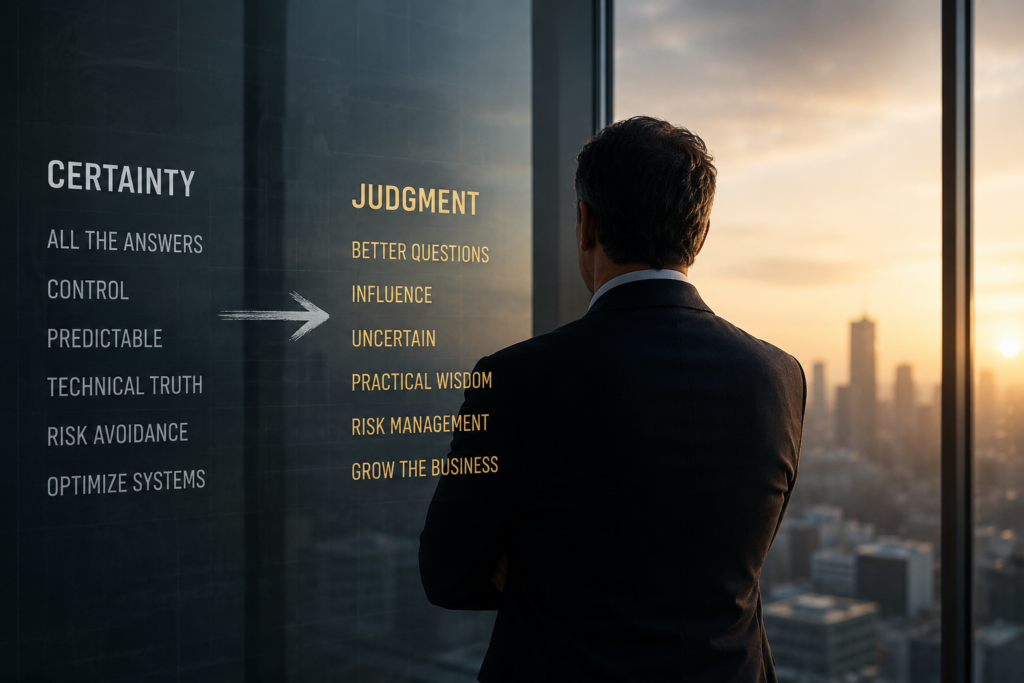
For much of my career, I lived in worlds where precision mattered. The hardest shift from a technology or security leader to CEO is trading certainty for judgment. In this executive leadership world a key ability is being able to lead with confidence when certainty disappears.

From Precision to Ambiguity

As a technologist, architect, CTO, and CISO, I was trained to look for edge cases, root causes, system behavior, technical truths, and to have defensible answers. When something failed, the goal was to understand why as soon as the disaster was dealt with. When risk surfaced, the goal was to measure it, contain it, and communicate it. When a system needed to scale, the goal was to design something resilient enough to survive negative impact.

That background is incredibly valuable as it sharpens how you think. It also teaches you to respect complexity while separating signal from noise. That operating system also gives you a deep appreciation for how fragile things can become when assumptions go untested.

The Real Shift: Certainty to Judgment

Becoming a CEO requires a different operating system.

The hardest shift is not going from technology to business. It is going from certainty to judgment.

In technical leadership, you often have the luxury of eventually getting to a correct answer. The system works or it does not. There is a reality to a functional state. A control is effective or it isn’t. An architecture scales or it breaks. Vulnerabilities are exploitable or they aren’t. Even when there is debate, there is usually a path toward some solution.

As CEO, the path is rarely that clean.

Leading When the Answer Is Not Obvious

Unfortunately, CEOs have to make decisions with incomplete information. That is simply part of the job’s reality. You balance financial realities, customer needs, market timing, employee morale, board expectations, competitive pressure, and operational constraints. There is a mental state where you are constantly choosing between options that all carry risk. Sometimes the decision is not between right and wrong. It is between imperfect and necessary.

That is a very different kind of pressure.

Risk Is Only One Part of the Equation

A CISO is often rewarded for identifying what could go wrong. A CEO is responsible for deciding what must go forward irrespective of risk.

That does not mean ignoring risk. It means understanding that risk is only one part of the enterprise equation. Growth has risk. Inaction has risk. Delay has risk. Over-analysis has risk. Moving too slowly can be just as damaging as moving too fast.

This was one of the most important mindset changes for me.

As a security leader, I spent years helping organizations avoid bad outcomes. I analyzed as many angles as I could and prepared in the most realistic way possible. As a CEO, I still care deeply about avoiding bad outcomes, but I also have to create the conditions for positive outcomes. After all, I have a company to run and grow. That means building momentum, making tradeoffs, allocating capital, setting priorities, developing leaders, and helping the company move with conviction even when the data is not perfect. Sometimes it means deciding between a gamble that could improve ARR or mitigating risk.

Technical Depth Can Become a Constraint

As expected, technical leaders often bring a powerful bias toward depth. We want to understand details and inspect machinery. Often, knowing why something is happening is essential before action takes place.

That instinct is useful. But it can also become a constraint.

As an example, imagine a scenario where sales leadership does not know intimate details about a potential customer. You ask questions such as who the economic buyer really is, what the internal deadlines are, or what their budget is. These are details that dictate how real a deal is and whether you put that data in front of the board. But realistically, those details are likely not made known to a sales person by the potential customer. My bias for depth just became both a constraint and source of frustration.

The CEO’s Job Is to Build Decision Capacity

Realistically, a CEO cannot personally inspect every system, approve every decision, or resolve every ambiguity. The job is not to become the ultimate escalation point for every hard problem. Staying focused, as a CEO you want to build an organization that can make better decisions without waiting for you.

That requires trust.

Trust in people, in operating rhythms, in the quality of the strategy, in the mechanisms that surface truth early. It also requires a leadership tier that understands the business, mission, constraints, and relevant standards.

As a CEO you must accept that no amount of technical brilliance eliminates uncertainty.

Judgment Is the CEO’s Most Important Tool

Given the reality of uncertainty, judgment becomes the CEO’s most important tool.

Judgment is not instinct alone. Nor is it guessing. Judgment is the ability to combine facts, experience, pattern recognition, timing, and foreseen consequences into a decision that moves the organization forward.

Good judgment asks:

  • What do we know?
  • What do we not know?
  • What assumptions are we making?
  • What happens if we are wrong?
  • What must be true for this decision to work?
  • What is the cost of a given decision?
  • What is the cost of not deciding now and waiting?
  • Who needs clarity now?

A Practical Framework for Leading When Certainty Disappears

Confidence under uncertainty does not come from pretending to have all the answers. It comes from using a disciplined process to turn incomplete information into responsible action. When the path forward is unclear, I use the following eight steps:

Accept That Certainty May Not Arrive

Recognize that consequential leadership decisions often must be made before every fact becomes available. Waiting for complete certainty can become its own decision, carrying costs and risks that may exceed those of taking action.

Separate What You Know From What You Do Not Know

Identify the reliable facts, the missing information, and the areas where uncertainty remains. This type of compartmentalization prevents assumptions, opinions, and incomplete signals from being treated as established truth.

Expose Your Assumptions

Make the assumptions behind the decision explicit and determine which ones carry the greatest risk. An assumption left unspoken can quietly become a serious risk and even a single point of failure.

Evaluate the Consequences

Consider what happens if the decision is wrong and how the effects could spread across the organization. Look beyond the immediate outcome to the potential larger impact on customers, employees, cash, execution, and credibility.

Compare Action With Inaction

Assess the cost of acting, the cost of waiting, and the risks created by delay or excessive analysis. Inaction can be very expensive. Leaders often examine the downside of moving forward without giving equal attention to the downside of standing still.

Define what must be

Determine the conditions required for the decision to succeed. Then assess whether those conditions already exist, can be created, or depend on factors outside the organization’s control.

Make and communicate the decision

Establish a clear direction, explain what matters most, and give the people who must act the clarity they need. Communicate what you know, what you believe, what you have decided, and what the organization must do next.

Adapt as reality provides new information

Lead as transparently as possible, with honest conviction rather than false certainty. Monitor the results, test the assumptions behind the decision, and adjust the course as new facts emerge.

This process does not eliminate uncertainty. It creates the decision capacity required to move through it responsibly. The objective is not to predict every outcome. It is to make the strongest available decision, communicate it clearly, and remain ready to adapt.

The Company Is Now the System

Some of those questions are familiar to technical leaders. They sound a lot like risk analysis, incident response, architecture review, and threat modeling. The difference is that, as CEO, they now apply to areas (e.g., Sales, Marketing, HR) technical leaders seldom manage. In fact, they now apply to the whole company.

Strategy becomes an architecture problem. Culture becomes a scaling problem. Communication becomes a signal integrity problem. Talent becomes a resilience problem. Cash becomes an operating constraint. Execution becomes the ultimate proof point.

The CEO role forces you to widen the aperture.

You can no longer look only at whether something is functional or technically sound. You have to ask whether it is commercially viable, operationally executable, strategically aligned, and fiscally responsible. You have to think about how decisions cascade across customers, employees, investors, partners, and the broader market.

Credibility Changes at the CEO Level

That broader blast radius for each decision made is where the CEO transition can feel uncomfortable for deeply technical leaders.

We are used to being credible because of what we know. As CEO, credibility increasingly comes from how we decide, how we communicate, and how we create clarity for others, even when conditions are hazy.

The organization does not need the CEO to have every answer.

It needs the CEO to establish clear direction.

It needs the CEO to make the hard calls.

It needs the CEO to define what matters most.

It needs the CEO to be calm when the data is incomplete and when the pressure is on.

It needs the CEO to turn ambiguity into action.

Conviction Without False Certainty

To be clear, none of this means pretending to be certain. In fact, false certainty is dangerous. People can feel when a leader is manufacturing confidence. The better posture is honest conviction: here is what we know, here is what we believe, here is what we are going to do, and here is how we will adapt as reality teaches us more.

That is a different kind of leadership maturity.

The transition from CISO or CTO to CEO is not a rejection of technical depth. It is an expansion of it. The same disciplines still matter: systems thinking, adversarial understanding, resilience, risk management, architecture, and operational rigor.

The difference is that they must be applied at a broader level.

The company is now the system.

The market is now the threat model.

The competition is now an adversary.

The strategy is now the architecture.

The people are now the execution layer.

And the CEO is responsible for whether all of it works together under pressure.

Your Expertise Got You Here. Judgment Determines What Happens Next.

For technical leaders aspiring to broader executive roles, this is the real lesson: your expertise got you to the table, but judgment determines your impact once you are there.

Depth still matters. Precision still matters. Technical fluency still matters.

But the role changes.

You are no longer only protecting the business.

You are leading it.

You are growing it.

And leadership, at the CEO level, is the discipline of making consequential decisions before certainty arrives.