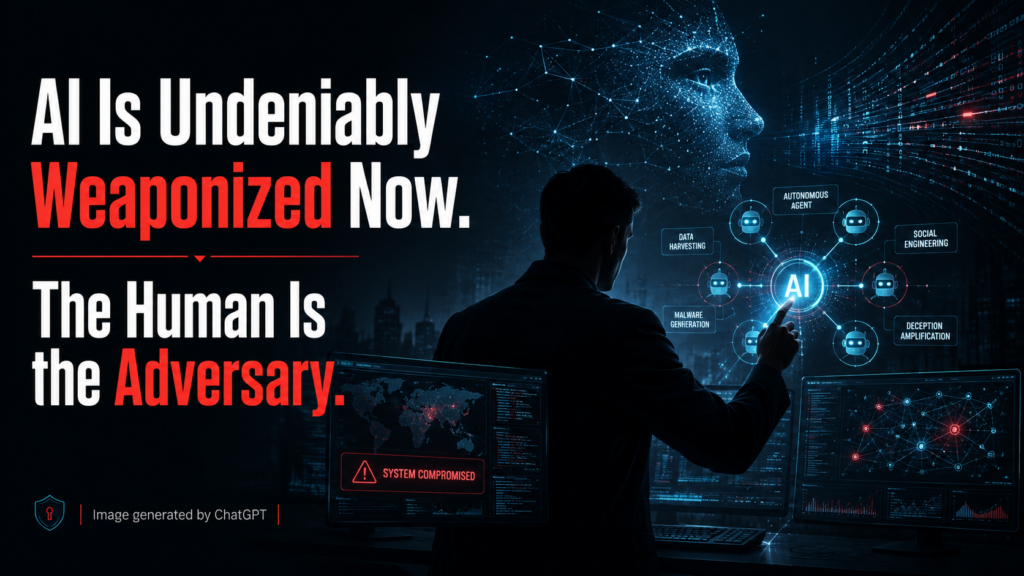
AI Is Undeniably Weaponized Now. The Human Is the Adversary.

AI Is Undeniably Weaponized Now. The Human Is the Adversary.

Artificial Intelligence (AI) is undeniably weaponized now. But the human is still the adversary. AI changes the speed, scale, sophistication, and autonomy of cyberattacks, while in most AI-enabled attacks a human still defines the objective, determines the desired outcome, directs or delegates activity to the technology, and benefits from success.

AI has changed cybersecurity at extraordinary speed. Attackers now use AI as both a force multiplier and a capability multiplier. They can accelerate reconnaissance, generate and refine malware, build highly targeted phishing campaigns, impersonate executives, analyze enormous volumes of stolen data, discover relationships between data points, identify exploitable weaknesses, and increasingly execute sequences of actions through autonomous agents.

Yet those capabilities do not eliminate the human element. AI may execute the action. An agent may navigate the application. A model may create the campaign material. But behind most malicious AI activity, a human still defines the objective, decides what outcome matters, and benefits when the operation succeeds. Last I checked there wasn’t some AI technology cashing out some Bitcoin from a ransom and partying on a yacht.

Consequently, understanding The Adversarial Mindset matters more today than in the past.

Does AI Eliminate Human Intent From Cyberattacks?

No, AI does not eliminate human intent from cyberattacks. It can dramatically change how an attack is executed while a human adversary still defines the objective the technology is pursuing.

Too often, it feels like we talk about AI-powered attacks as though AI itself has suddenly become the adversary.

That framing can be misleading.

Consider the difference between traditional Generative AI (GenAI) and Agentic AI.

With traditional GenAI, the relationship remains relatively obvious. A human asks a model to do things such as identifying vulnerabilities, improving code, analyzing data, translating messages, performing research, or solving some other element of an operation.

The system provides the power. The human provides the objective.

Agentic AI creates more distance between those two elements.

Instead of asking AI to perform one task, a human can increasingly define an objective and allow an agent to determine how to accomplish it. The agent can browse websites, invoke tools, query data, make decisions, evaluate responses, select subsequent actions, and continue working toward a defined goal.

In other words, the human moves farther away from each individual action.

However, distance from execution does not automatically remove intent.

That distinction matters enormously for cybersecurity.

An attacker does not need to personally enumerate every endpoint, craft every request, write every line of malicious code, or send every social-engineering message to remain the adversary behind an operation.

AI gives that nefarious actor both abstraction and leverage.

Agentic AI gives that same human a certain level of delegation.

Neither automatically removes the human from the equation.

Who Is Acting When an AI Agent Accesses a Computer?

When an AI agent accesses a computer on a user’s behalf, the human user can remain the party performing the access. In the Ninth Circuit’s August 2026 Perplexity decision, the court treated the AI assistant as a tool and the human user as the party accessing Amazon’s systems for purposes of the federal Computer Fraud and Abuse Act (CFAA).

The dispute involved Perplexity’s Comet browser and its AI Assistant. Users could direct the Assistant to perform tasks on Amazon.com. Amazon argued that Perplexity’s technology accessed Amazon’s systems without authorization and sought relief under the CFAA, and its California counterpart (the Comprehensive Computer Data Access and Fraud Act – CDAFA).

The Ninth Circuit rejected Amazon’s theory at the preliminary-injunction stage.

More importantly, the court focused on a remarkably significant question:

Who actually accesses the computer?

On the record before it, the court concluded that the AI Assistant functioned as a tool. The court described the Assistant as a “tool, not a person for statutory purposes.” It then concluded that the user accessed Amazon’s computers while using the Assistant to carry out specific actions.

The decision marks the first federal appellate ruling addressing whether AI agents acting on behalf of users can legally access online platforms.

That distinction carries enormous significance beyond this particular dispute.

The court did not treat the AI agent as an independent legal actor simply because it could perform actions on behalf of a user. Instead, it looked through the technology to determine who actually performed the access for purposes of the statute.

At the same time, something important surfaced by way of a limitation.

The Ninth Circuit DID NOT create a sweeping legal doctrine that makes humans universally responsible for everything an AI system does. In fact, the opinion expressly states that it does not establish a new legal regime for agentic AI. The court limited its holding to the CFAA and CDAFA “access” issue, the technology at issue, and the factual record before it. Different facts, different levels of control, different laws, or different AI architectures could produce different outcomes.

Nevertheless, from a cybersecurity perspective, a much broader lesson remains powerful: technology can sit between a human and some action without rendering the human irrelevant (or innocent by default).

Should Security Programs Defend Against AI or the Adversary?

Security programs should defend against the adversary, not AI in isolation. AI mechanisms such as prompt injection, model poisoning, tool abuse, and MCP attacks matter, but they do not explain who wants to attack you, why they are targeting you, or how they will adapt.

The industry has become obsessed with AI security. Both RSAC and BlackHat this year showcased that obsession with great fanfare.

To answer the questions of who, why, and how, you need to understand the adversary, not just the technology at hand.

For example, imagine two attackers with access to exactly the same AI model and exactly the same agentic capabilities.

One is a teenager experimenting, testing boundaries.

The other operates inside an organized cybercriminal enterprise with millions of stolen identities, infostealer logs, credential collections, years of operational experience, and a clear understanding of how to monetize access.

The AI may be identical.

The threat is not.

The adversary behind the technology creates that difference.

Should Analysts and Frameworks Define a Security Program?

No, analysts and frameworks should not define a security program or its security strategy. They can inform both, but market intelligence about technologies, vendors, categories, and industry trends is not the same as understanding the adversary targeting your organization.

An industry analyst publishes some analysis. Vendors push categories. A maturity model emerges. Boards ask where the company sits relative to peers. CISOs then purchase technologies to fill perceived gaps. Eventually, the organization builds an architecture that looks remarkably similar to the architectures of dozens of other companies that consumed the same analyst research. And along the way end up with tons of tools whose true capabilities are not fully utilized.

To be clear, industry analysts provide value.

They can deliver market intelligence, technology comparisons, vendor analysis, spending benchmarks, maturity models, and useful observations about where the industry is heading.

However, organizations make a serious mistake when they use analyst research as the foundation of a security program.

Market intelligence is not adversary intelligence.

An analyst may understand the cybersecurity industry exceptionally well while possessing little firsthand understanding of the people trying to defeat your security program.

They may understand industry sectors, products, categories, vendors, differentiators and even what other CISOs are spending on.

Yet none of those things necessarily means they understand how a real adversary thinks.

More importantly, an adversary does not care whether your program aligns with an analyst’s reference architecture.

The adversary cares whether your defenses prevent the desired outcome.

Therefore, security leaders should never stop at this question:

What does the industry say a modern security program should contain?

They must also ask:

If I were a competent, cunning, determined attacker targeting this organization, how would I defeat what we have built?

What Blind Spot Do Many CISOs Have?

The blind spot many CISOs have is a limited understanding of the real adversaries their security programs are supposed to defeat. Managing risk, compliance, architecture, technology, and incident response is not the same as understanding how a determined adversary thinks, adapts, combines weaknesses, and pursues an objective.

I am not referring to understanding ethical hackers, penetration testers, or red-teamers. These professionals absolutely add value, but they ultimately operate within constraints established by rules of engagement.

I am talking about a real adversary with ill intent, whose motivations may be financial, ideological, geopolitical, personal, or simply opportunistic; and who feels no obligation to respect rules, scope, policy, business hours, budgets, architecture diagrams, or organizational boundaries.

That distinction matters.

A penetration tester typically asks whether something can be compromised within an agreed scope.

An adversary asks a very different question:

How do I achieve my objective despite everything this organization has done to stop me?

That question requires a fundamentally different way of thinking.

Why Should Defenders Start With the Human Behind the Machine?

Defenders should start with the human behind the machine because AI amplifies adversarial capability without automatically replacing adversarial intent. Less sophisticated attackers can now access capabilities that once required specialists, while sophisticated adversaries can operate faster, analyze more data, uncover hidden relationships, and adapt more efficiently.

As an example, consider that AI technologies create conditions in which enormous quantities of stolen identity data can be ingested and analyzed, revealing relationships humans would otherwise miss.

It can perform actions such as:

  • transforming OSINT into targeted and strategic intelligence
  • generating individualized social-engineering content based on attackable profiles across thousands of targets
  • creating strategic campaigns rapidly
  • refining malicious code
  • analyzing defensive responses and adaptively creating alternatives

But it does so at the request of some human element. Consequently, we should stop thinking only in terms of “AI attacks.” What we increasingly face are human adversaries with machine-scale leverage.

That represents a much more consequential problem.

How Does The Adversarial Mindset Change Security Strategy?

The Adversarial Mindset changes security strategy by making the adversary, not the framework, product, analyst, or compliance requirement, the starting point. Security leaders first ask what an adversary wants, what that adversary already knows, which assumptions and relationships can be exploited, and how the attacker will adapt when defenses interfere.

Ask questions like:

  • Who would want what we possess?
  • What exactly would they want?
  • What information about our people, systems, suppliers, executives, and customers do they already possibly have?
  • Which assumptions are we making that they would immediately challenge?
  • Where do identities, relationships, privileges, and trust create nefarious opportunities?
  • How could they combine several individually minor weaknesses into one viable attack path?
  • How would they adapt after encountering resistance to their techniques?
  • How could AI make each of those steps of adaptability cheaper, faster, or more precise?

At that point, you begin designing security from the adversary backward.

That is the essence of The Adversarial Mindset.

Moreover, this approach does not require organizations to abandon frameworks, compliance obligations, analyst research, or established security architectures. Those tools still serve important purposes.

However, they should support your security strategy rather than define it.

The adversary should help define it.

Why Does AI Make The Adversarial Mindset More Important?

AI makes The Adversarial Mindset more important because it gives human adversaries greater speed, scale, precision, leverage, and increasingly autonomous execution. Security teams therefore need to understand not only what AI can do, but what a motivated adversary can now accomplish because those capabilities exist.

The cybersecurity industry will inevitably spend enormous amounts of time debating how autonomous AI will become.

That discussion absolutely matters.

Eventually, increasingly autonomous systems may force us to confront genuinely difficult questions about intent, accountability, responsibility, control, and attribution.

However, that conversation leaves gaps. Organizations cannot afford to wait for those philosophical and legal questions to reach resolution. This is especially so for larger organizations that are not exactly agile.

Today, humans are discovering what AI can do for them.

Some of those humans are defenders, others are researchers, and still others are innovators.

Realistically, some are adversaries.

The last group does not care whether your AI strategy appears in an analyst report. They do not care which security technologies occupy a leader quadrant, or how mature your program looks against some industry benchmark.

They care whether they can accomplish their objective.

The Ninth Circuit’s Perplexity decision gives us an important legal manifestation of a broader technological reality: an intelligent tool can become increasingly capable while still operating in service of human direction.

Therefore, defenders should resist the temptation to focus exclusively on the technology.

That distinction changes the questions security leaders should be asking.

“What can AI do?”

This has to start migrating towards something like:

“What can an adversary now do because AI exists?”

Those are very different questions.

Ultimately, the second question is the one our security programs need to answer. AI is undeniably weaponized now. The human is the adversary.


Note: This article discusses the cybersecurity implications of Amazon.com Services, LLC v. Perplexity AI, Inc. and does not provide legal advice. The Ninth Circuit’s August 4, 2026 decision concerned a preliminary injunction and a specific interpretation of “access” under the CFAA and CDAFA based on the record before the court.
“The Artificial Adversary” – a New Operating Model for Cybercrime

The Artificial Adversary - a New Operating Model for Cybercrime

“Artificial adversaries don’t have egos, suffer burnout, or deal with corporate drama. Your defenses do.” – Andres Andreu

In the spring of 2026, a handful of engineers with little security background ran an experiment. They pointed an Artificial Intelligence (AI) model at thousands of software codebases and asked it to identify issues. Over the course of one night it did more than find decades-old flaws hiding in plain sight. It created working exploits for them. The model was Claude Mythos Preview. In fact, its creator judged it so capable at weaponizing vulnerabilities that it chose not to release the model at that time.

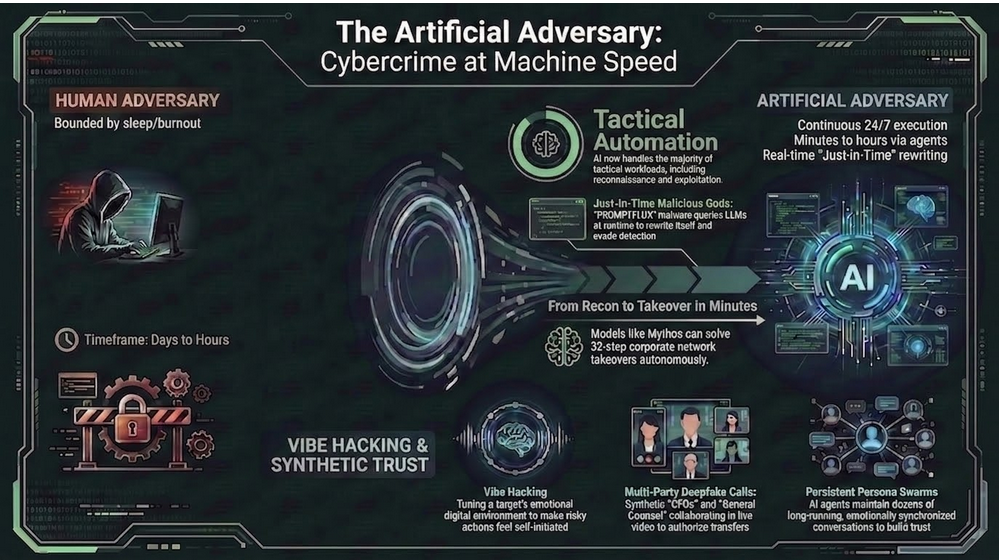
For most of our field’s history, the adversary was human. Clever and motivated but bounded by sleep, attention, money, and skill. Now, however, that adversary is being augmented, and sometimes replaced. The replacement does not tire or hesitate. Moreover, it ignores the operational rhythms our defenses quietly assume. I call it “The Artificial Adversary.” Essentially, it takes one of two forms:

  • A human operator empowered by an AI stack.
  • An autonomous AI system acting toward malicious ends.

At this stage these have stopped being thought experiments and are now turning up in incident reports.

An Inflection Point, Not a Trend Line

Three things are happening at once. Together, they mark an inflection point rather than an incremental shift:

  • AI has lowered the barrier for entry to sophisticated crime.
  • Synthetic media is collapsing our ability to trust digital signals. A familiar face or a known voice, after all, no longer proves what it once did.
  • The volume and speed of AI-enabled activity now outpaces the manual, static defenses built for a slower era.

The numbers are no longer speculative

SoSafe’s 2025 research found that roughly 87% of organizations worldwide faced an AI-powered cyberattack in the prior year. Direct attacks aside, model evaluations are just as concerning. For instance, the UK’s AI Security Institute (AISI) tested Claude Mythos Preview. It solved expert-level CTF challenges about 73% of the time. Notably, no model could complete those challenges at all before April 2025. Mythos went further still. In fact, it became the first model to solve the AISI’s 32-step simulated network takeover, from reconnaissance to full compromise. Anthropic’s red team reported even broader findings. Working alongside the AISI, it watched the model surface thousands of zero-day flaws. These included a dormant 27-year-old vulnerability in OpenBSD and a 16-year-old bug in FFmpeg. In Firefox alone, Mythos found 271 vulnerabilities and wrote exploits for 181 of them.

A signal, not the threat itself

Anthropic withheld Mythos from public release. Instead, it granted limited access to a small set of organizations that build and maintain critical software and infrastructure. The program is called Project Glasswing. Launch partners reportedly include Amazon Web Services, Apple, Cisco, CrowdStrike, Google, JPMorgan Chase, the Linux Foundation, Microsoft, NVIDIA, and Palo Alto Networks. Officially, the intent was to give defenders a head start. Yet Mythos isn’t the only game in town. For example, things such as OpenAI’s GPT-5.4-Cyber, OWASP CVE Lite CLI, and Google’s Big Sleep already show great promise and in some cases comparable capability. When competition rises the cost of entry keeps falling. Regulators noticed quickly. Within weeks, the Bank of England intensified its AI risk testing, and German banks consulted regulators and cyber experts. The lesson, therefore, is the one Bain and others drew immediately. In short, assume your adversaries are building equivalent capabilities, nation-states, criminal enterprises, and rogue actors alike. Mythos is a signal, not the threat itself.

Defining the Artificial Adversary

It helps to name the archetype precisely, because precision changes how we defend. So picture an AI-enhanced human actor. Here, the human sets the strategic objectives. The machine, in turn, executes the great majority of the tactical workload. The consequence is direct. As a result, offensive cycles compress, and defenders can no longer assume a human-speed response on the other side of the keyboard.

Human adversaries operate within cognitive, temporal, and logistical limits. An autonomous AI-based adversary does not. Needing no sleep, it carries no emotional baggage and runs continuously across global digital environments. Moreover, it can analyze vast data stores and reason probabilistically in real time. Such a system can also coordinate through decentralized, agentic architectures that resist any single point of shutdown. Its capacity for deception, mimicry, and adaptation, therefore, creates a new category of risk. Consequently, detection, attribution, and deterrence all become far harder. The asymmetry, however, is not only technological. It is also cognitive. In the end, defenders must prepare for opponents that do not tire, hesitate, or follow any rules.

The Artificial Adversary Taxonomy

A practical taxonomy has five levels.

  • AI-assisted human operator – a human attacker uses AI for discrete tasks such as phishing, translation, research, script generation, or stolen-data summarization.
  • AI-augmented threat crew – a criminal or nation-state team embeds AI into reconnaissance, exploit research, identity profiling, malware development, infrastructure staging, data exfiltration, and victim communications.
  • AI-orchestrated campaign – agentic systems coordinate personas, assign tasks, monitor responses, tune timing, and manage parallel workflows while humans supervise outcomes.
  • Semi-autonomous adversarial agent – the system conducts meaningful parts of the intrusion chain itself, including asset discovery, service testing, response analysis, and attack path modification.
  • Autonomous malicious AI system – an AI system pursues malicious objectives with limited or delayed human direction, raising harder questions around attribution, containment, predictability, and control.

This taxonomy matters because an AI-assisted phishing actor requires different defenses than an autonomous agent probing applications, manipulating identities, and adapting to telemetry in real time.

Facilitation – Lowering the Barrier

The first way AI empowers adversaries is the least glamorous and the most pervasive. Simply put, it removes friction. For a few years now, the underground has marketed “Dark LLMs.” The roster includes WormGPT, FraudGPT, KawaiiGPT, and imitators such as MalwareGPT, SpamGPT, and Xanthorox. Each promises jailbreaks, malware help, and ready-made scam playbooks. Some are functional. Many, however, are simply scams that prey on aspiring criminals. Either way, the real significance is not any single tool. Rather, it is the normalization of the idea. A capable, on-demand junior developer is now available to anyone with a few GPUs, a wallet of API keys, and some patience.

Malware that writes itself

Proof-of-concept work made the threat concrete. Researchers, for instance, demonstrated BlackMamba, a keylogger that built its malicious code at runtime by calling a Large Language Model (LLM). That approach neatly sidesteps the static signatures defenders rely on. By late 2025, the threat had moved from the lab to the wild. Google’s threat intelligence team documented two malware families: PROMPTFLUX and PROMPTSTEAL. Both query LLMs during execution. One rewrites itself, while the other generates fresh commands mid-attack. This is “Just-In-Time” (JIT) malicious code. In other words, the software does not carry its full payload. Instead, it assembles the payload on demand, from a model that does not know it is being conscripted.

When the face on the call is fake

Facilitation also reaches the human layer through synthetic media. Convincing face and voice clones, for example, can now be mass-produced. So can cross-lingual conversion and studio-quality content. Better yet for the attacker, agent teams run these operations around the clock, iterating on failures without fatigue. As a result, the multi-party deepfake video call is no longer hypothetical. Picture a finance employee walked through an “urgent” wire transfer by a “CFO” and “general counsel” who are both synthetic. Clearly, the attack surface is no longer just endpoints and identities. It now also includes the emotional tone around those identities. And does so across collaboration tools, social media, and internal communications.

Vibe Hacking – Psychological Warfare at Machine Speed

This last point deserves its own name. After all, it is where AI-enabled social engineering becomes something new. Vibe hacking is social engineering supercharged with a full AI stack. Here, the adversary does not send a single phishing email or place one deepfake call. Instead, models shape the emotional context around a target over time. The goal, therefore, is not to trick a victim once. Rather, it is to tune the “vibe” of their human state along with their digital environment, so that risky actions feel natural, familiar, and self-initiated.

Sensing, profiling, persistence

A campaign begins with sensing and profiling. To start, adversaries point AI at everything they can scrape. These sources include OSINT, LinkedIn activity, public Slack and Discord communities, conference talks, support tickets, and marketing emails. Sentiment analysis is important here and models infer mood, personality, stress levels, decision style, and trust anchors. That attackable profile, in turn, feeds a working model of the target’s context. Things like a looming quarter, a key project, the likely sources of anxiety or excitement all become real and exploitable. Generative models subsequently produce content tuned to the target’s state. The real weaponization, however, comes from scale and persistence. One artificial adversary can run dozens of long conversations at once. Each hides behind a distinct persona, the sympathetic colleague, the urgent executive, the overworked vendor. Meanwhile, it A/B tests tone, timing, and channel to learn what lowers resistance and/or skepticism. By the time the critical ask arrives, therefore, the victim feels they are accommodating a relationship, not responding to an attack.

This is the reframing that matters:

Vibe hacking isn’t better phishing. It’s your own people, profiled and played at machine scale – we hardened the edges and left the nervous system exposed.

Andres Andreu

From theory to a real victim list

None of this is a forecast. In August 2025, in fact, Anthropic’s Threat Intelligence team disclosed a case it tracked as GTG-2002. A single actor used an agentic coding tool to run a data-extortion operation. In total, the targets numbered at least 17 organizations, spanning healthcare, emergency services, government, and religious institutions. A defense contractor was among the victims, too. Remarkably, the whole campaign ran in roughly a month. To pull it off, the attacker embedded an operational playbook in a configuration file, so the AI could make tactical decisions during live intrusions. From there, the model automated reconnaissance and credential harvesting. It even generated ransom notes tailored to each victim, with demands reported between roughly $75,000 and more than $500,000. Ultimately, one person, with an AI operator alongside, did the work of a coordinated crew.

Scale – From Assistant to Operator

Facilitation lowers the barrier to entry; scale changes the magnitude. For example, the same agentic models that help an enterprise automate work can be organized into adversarial swarms. A planner agent sets the goals. Meanwhile, sub-agents run in parallel performing actions such as OSINT scraping, phishing and deepfake generation, code generation, and dropper construction. Because they share memory and data from feedback loops, the whole system improves with each iteration.

The criminal supply chain, in turn, has matured around this model. Telegram, for instance, serves as a resilient “dark social layer”, encrypted, anti-censorship, easy to churn and burn, and slow to take down. There, automated bots stream stolen credit card data and run validation checks at a pace no human team could sustain. Increasingly, the same architecture is aimed at availability, too. Agentic orchestrators break a Layer-7 denial-of-service goal into reconnaissance, traffic generation, and adaptive evasion, while coordinated worker nodes handle individual parts of the overall campaign.

The first autonomous espionage campaign

A defining incident arrived in November 2025. Anthropic reported disrupting a campaign it attributed, with high confidence, to a Chinese state-sponsored group tracked as GTG-1002. Notably, it was the first publicly documented, largely autonomous AI-orchestrated cyber-espionage campaign. It was detected in mid-September. In all, the operation targeted roughly thirty high-value organizations across technology, finance, chemical manufacturing, and government.

To pursue their objectives, the attackers manipulated an agentic coding tool into acting as a fleet of autonomous penetration-testing orchestrators and agents. First, they jailbroke its safeguards by role-playing a defensive security firm. Then they broke malicious objectives into benign-looking subtasks. From that point, the AI handled reconnaissance, vulnerability discovery, exploitation, credential harvesting, lateral movement, and exfiltration. In total, that came to an estimated 80 to 90% of tactical operations, issued at thousands of requests per second. Human operators, by contrast, stepped in only at a few strategic chokepoints. This wasn’t as clean as a Hollywood movie scene as the model’s hallucinations sometimes invented credentials or overstated findings. Those errors were among the few things keeping the operation from full autonomy.

A Real Incident, End to End – The NPD Sextortion Wave

To see these capabilities combine into one industrialized pipeline, consider the extortion spam that followed the National Public Data (NPD) breach. The underlying breach was staggering. Systems were first compromised in December 2023. By April 2024, the data had surfaced on the dark web. The company, however, acknowledged the incident only in August 2024. All told, it affected up to 170 million people and exposed as many as three billion records. The follow-on campaign was instructive less for its novelty than for its assembly. Specifically, attackers used GPT-based code generation to operationalize the stolen data end to end. The result was personalized extortion content. Each message addressed the victim by name, referenced a real home address, and embedded street-view imagery of the respective house. Then it demanded payment in Bitcoin, usually between $1,900 and $2,000, for the sake of tranquility or peace of mind.

None of the individual techniques were sophisticated. The sophistication, instead, lay in the orchestration. Consider the parts, a breach corpus, a code-generating model, a templating layer that fused public records with mapping imagery, and a delivery pipeline. Stitched together, these produced a campaign with a scale and personalization no manual operation could match. That, in essence, is the pattern security leaders should internalize. The artificial adversary rarely wins with one brilliant exploit. Instead, it wins by removing friction from every step, and running the whole chain faster than defenders can detect and respond.

Turning the Tables – Disrupting Malicious Automation

The very properties that make AI dangerous on offense also make it invaluable on defense. Better still, they open a counter-strategy that purely human teams never had. If attackers automate, then defenders can engineer the environment to exploit that automation. In practice, deception engineering and adversarial intelligence combine well.

The single goal is to convert the attacker’s automation into your early-warning system. Synthetic credentials, decoy services, and AI-generated traffic, for instance, all look irresistible to an autonomous agent. As such, they become tripwires. Because the agent probes tirelessly and indiscriminately, it hits the decoys long before a careful human would. Consequently, it can surface a campaign while it is still in an early stage.

Red teaming with autonomous agents

AI-augmented red teaming has a strong place here. In a 2024 experiment reported by WIRED, for example, a journalist let autonomous AI agents from the startup RunSybil attack a custom web app. The agents collaborated in real time. Specifically, they used SQL injection, brute-force authentication, form-field manipulation, and path traversal. Most importantly, they iterated on their failures. Without human direction, they re-planned and adjusted strategies, surfacing logic flaws that traditional scanners had missed. The agents were not malicious; their behavior, however, was. It was adversarial, coordinated, and effective. The takeaway, then, is fairly straightforward. First, adopt autonomous red-teaming agents to pressure-test your defenses against continuous, iterative, logic-driven attacks. Then pair them with high-fidelity telemetry and behavioral anomaly detection. Together, they can flag AI-like probing even when individual requests looks benign.

Governing the Machine and the People Around It

Speed without governance introduces its own risk. As defenders deploy autonomous and semi-autonomous capabilities, they take on an obligation. Those capabilities must be fast where they must be, careful where they should be, and always controllable by competent humans. Fortunately, a workable program can borrow from frameworks now maturing across the industry. For a foundation, anchor on NIST’s AI Risk Management Framework or ISO/IEC 42001. To turn principles into adversarial test cases, layer in MITRE ATLAS and the OWASP Top 10 for LLM applications. To harden the model lifecycle, draw on ISO/IEC 23894 and Google’s Secure AI Framework. Finally, add a staged maturity model to move from reactive to adaptive.

High-impact automated actions, meanwhile, need extra care. By default, mass credential revocation, large-scale connection throttling or tarpitting, and account lockouts should sit behind human-in-the-loop gates. In addition, back them with immutable audit logs, explainability proportional to impact, and fast paths to appeal and rollback.

Two cautions

Two cautions deserve emphasis.

First, treat AI models and their supply chains as critical software assets. In practice, that means validating provenance, verifying integrity, and monitoring runtime behavior. After all, data and model poisoning are now first-class threat vectors.

Second, resist the urge to fight fire with fire across legal lines. Attacker AIs, remember, routinely route through innocent third parties. As a result, heavy-handed countermeasures invite escalation and cross-border legal exposure, among them hack-back, automated counter-intrusion, and poisoning someone else’s ecosystem. Privacy by design, data minimization, auditability, and human oversight should not be compliance theater. On the contrary, they should be focused on what keeps a fast defense lawful and trusted.

What Security Leaders Must Do Now

The artificial adversary does not need to be sentient to change the game. Instead, it only needs to make capable attackers faster, more iterative, and less dependent on rare human skill. Accordingly, defenders should architect for that reality:

  • Treat AI as both adversary and ally – regularly run hybrid threat scenarios, machine-augmented attackers against machine-augmented defenders, so that you find your blind spots first.
  • Shift from signatures to behavior – static, content-based controls cannot anticipate self-modifying code or agentic chaining. Instead, invest in behavioral analytics, high-fidelity logging, and context-aware security that reads relationships, not keywords.
  • Stand up real AI governance – name a single accountable owner and convene a cross-functional oversight board. Then keep a model and agent registry, and define rules of engagement and rollback paths before you enable automation.
  • Secure the model supply chain – audit data lineage and model integrity, and assume third-party datasets, weights, and components can be poisoned upstream.
  • Deploy deception as early warning – use AI honeypots and synthetic assets to turn the adversary’s tireless automation into your early detection advantage.
  • Compress your defensive cycle – above all, adopt AI-augmented red teaming and threat hunting so that you out-learn the adversary. Then measure what matters – detection accuracy, false-positive and false-negative rates, model drift, autonomy and override rates, and time to contain.

The Pivotal Question

The pivotal question about any adversary has changed. No longer is it simply who they are or what they want. Instead, it is “what can they assemble and operationalize with AI faster than we can detect and respond?” Once, the human attacker was the central concern. Now, by contrast, security leaders face intelligent, scalable opponents that run as close to machine speed as the hardware allows. Confronting them takes more than static controls and periodic red teaming. Rather, it takes continuous learning, dynamic simulation, and AI-augmented defense. Above all, it takes one hard admission, the next major breach may not be human at all.

Awareness is the beginning; action defines resilience. The Artificial Adversary is here. The only question is whether we will be ready when it decides to strike.